- Length
- 373 pages
- Practice questions
- 1,119
- Mock · 180 min
- 130 Q
Study guide · 2026 edition
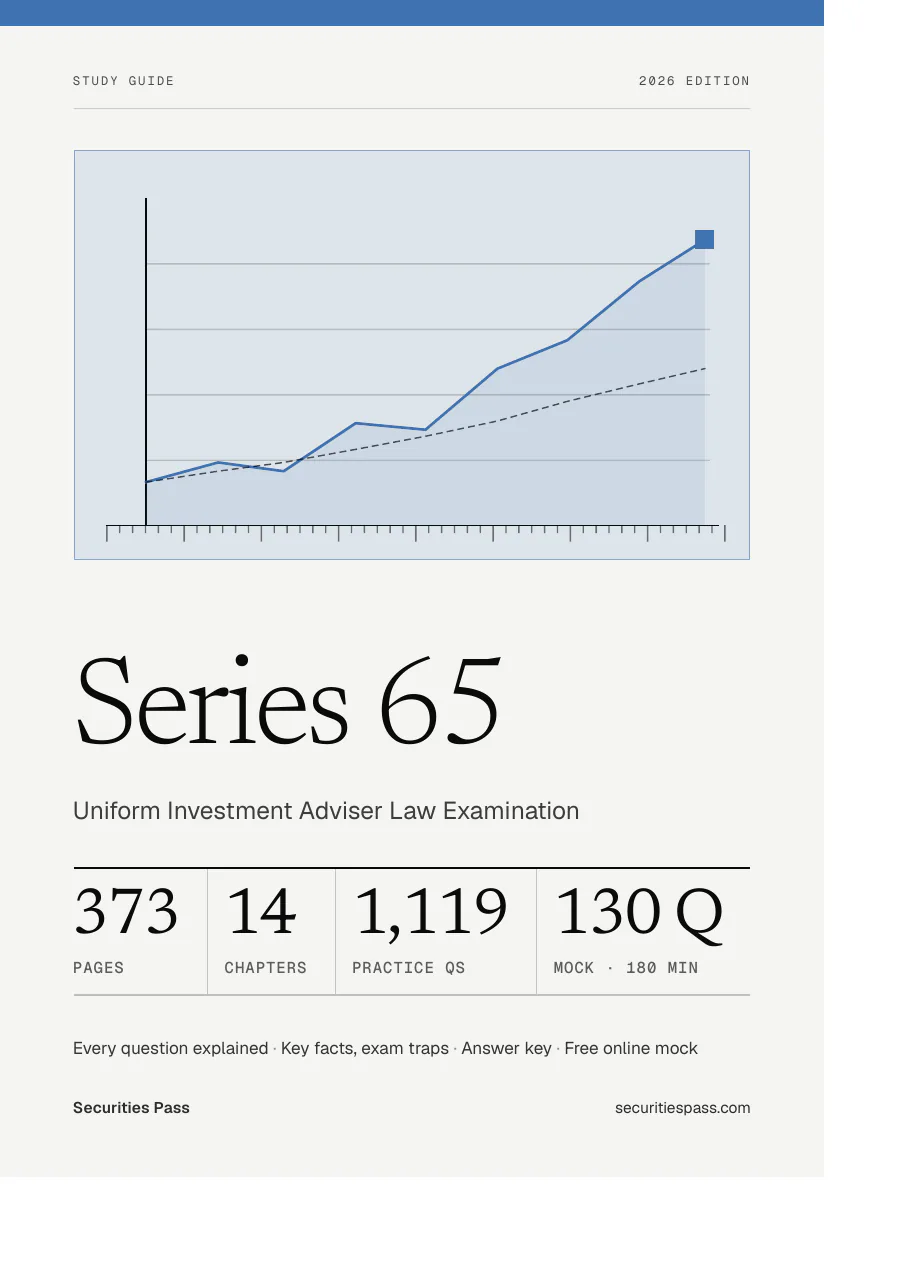
Series 65 Study Guide (2026)
Written chapter by chapter for the Series 65 exam, with every practice question explained and the working shown.
- Format
- PDF + EPUB
- Length
- 373 pages
- Practice questions in the book
- 1,119
- File last updated
- November 2026
- Delivery
- Instant download after payment
Your options for this exam
- Study guide$24.99You are looking at this one
- Cheat sheet$9.99See what is inside
- BundleGuide + cheat sheet$29.99Save $4.99 vs buying separately
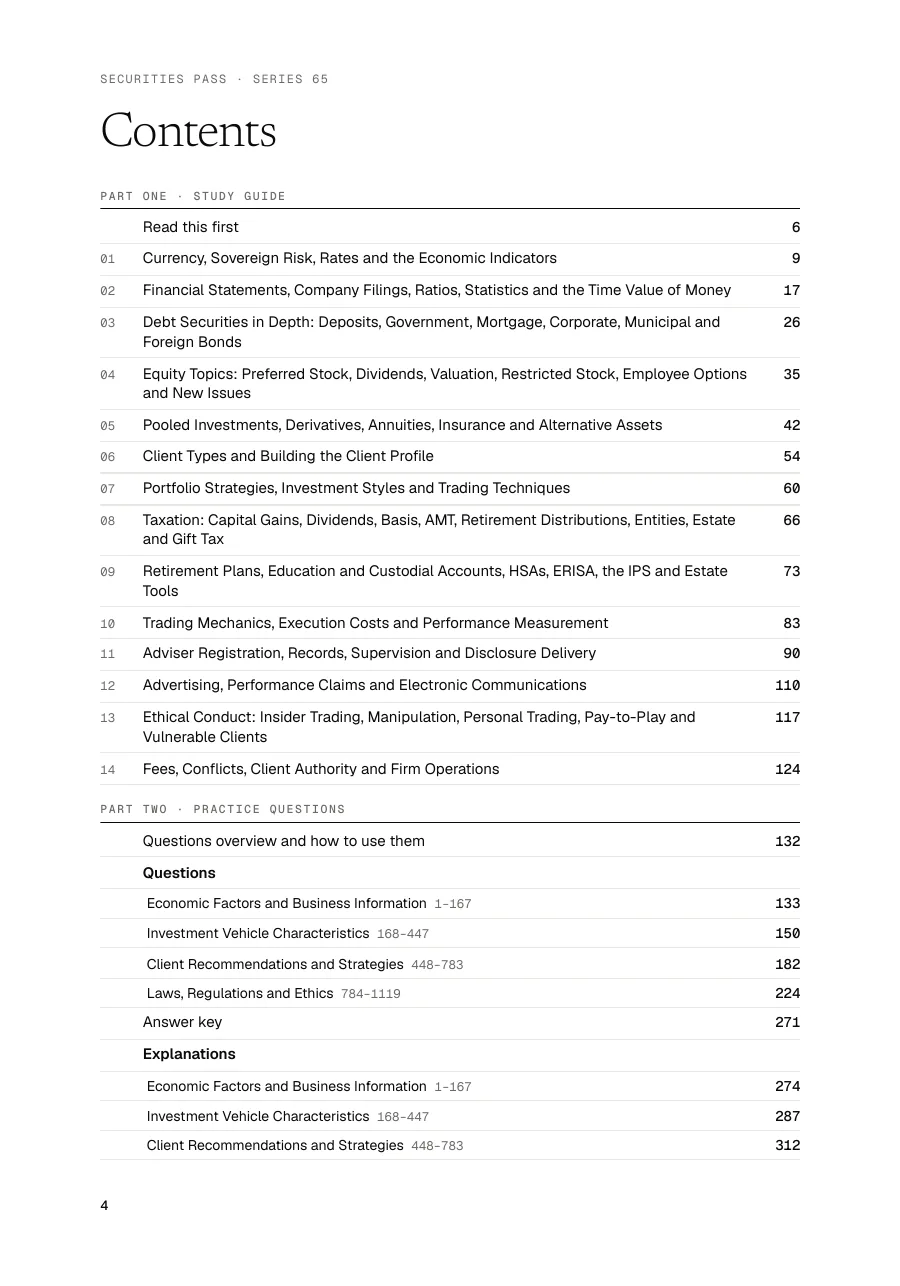
Contents
| Ch. | Chapter |
|---|---|
| 01 | Currency, Sovereign Risk, Rates and the Economic Indicators |
| 02 | Financial Statements, Company Filings, Ratios, Statistics and the Time Value of Money Free sample |
| 03 | Debt Securities in Depth: Deposits, Government, Mortgage, Corporate, Municipal and Foreign Bonds |
| 04 | Equity Topics: Preferred Stock, Dividends, Valuation, Restricted Stock, Employee Options and New Issues |
| 05 | Pooled Investments, Derivatives, Annuities, Insurance and Alternative Assets |
| 06 | Client Types and Building the Client Profile |
| 07 | Portfolio Strategies, Investment Styles and Trading Techniques |
| 08 | Taxation: Capital Gains, Dividends, Basis, AMT, Retirement Distributions, Entities, Estate and Gift Tax |
| 09 | Retirement Plans, Education and Custodial Accounts, HSAs, ERISA, the IPS and Estate Tools |
| 10 | Trading Mechanics, Execution Costs and Performance Measurement |
| 11 | Adviser Registration, Records, Supervision and Disclosure Delivery |
| 12 | Advertising, Performance Claims and Electronic Communications |
| 13 | Ethical Conduct: Insider Trading, Manipulation, Personal Trading, Pay-to-Play and Vulnerable Clients |
| 14 | Fees, Conflicts, Client Authority and Firm Operations |
Chapter numbers are those printed in the book.
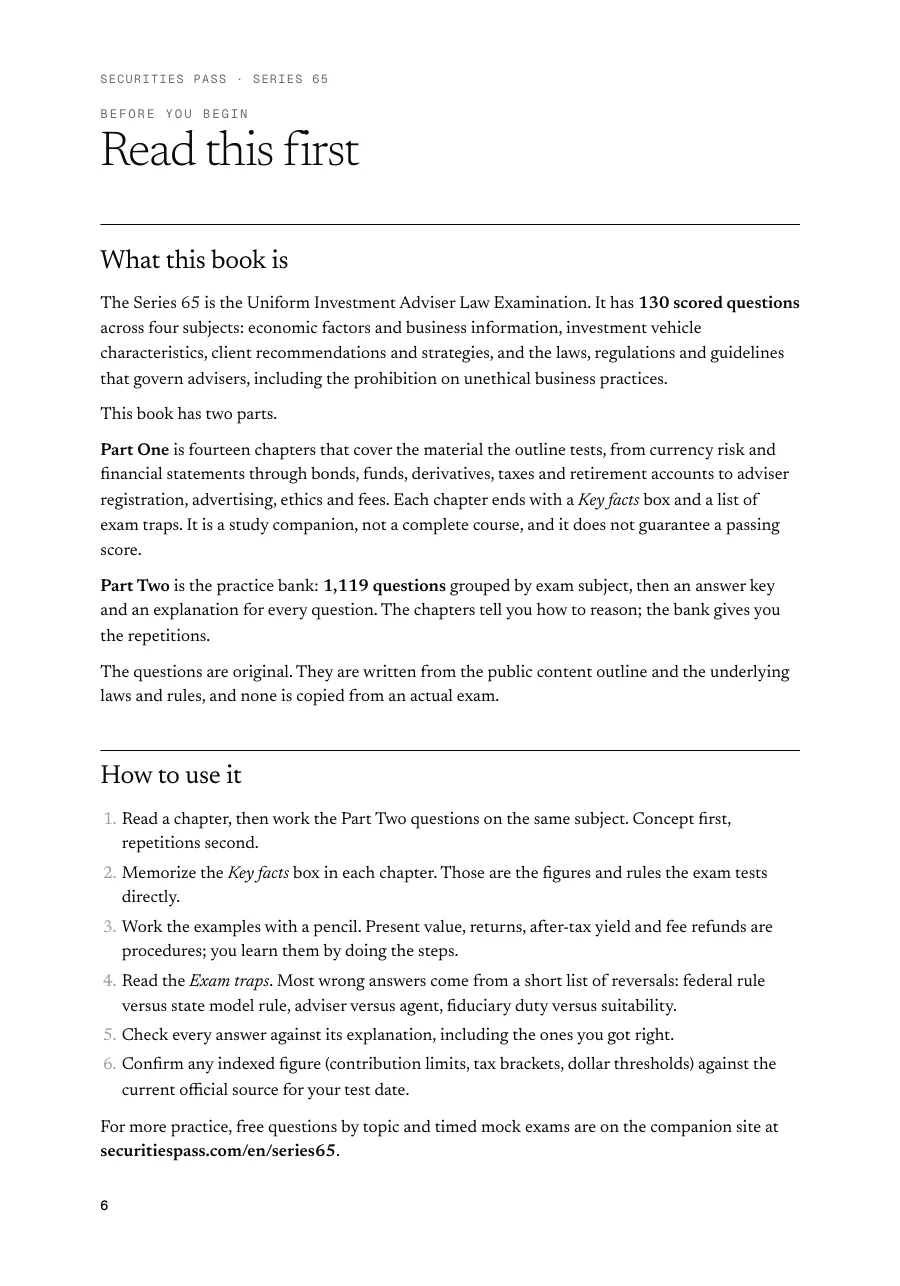
What’s inside
- Chapters in teaching order, written to the Series 65 content outline
- A question bank of 1,119 practice questions, grouped by topic, with answers and explanations
- Worked examples where the exam asks for arithmetic, and the traps named where candidates miss
- PDF (print and tab it) + EPUB (phone or e-reader)
Look inside
12 pages of the Series 65 guide, exactly as printed. Swipe, or use the arrow keys.
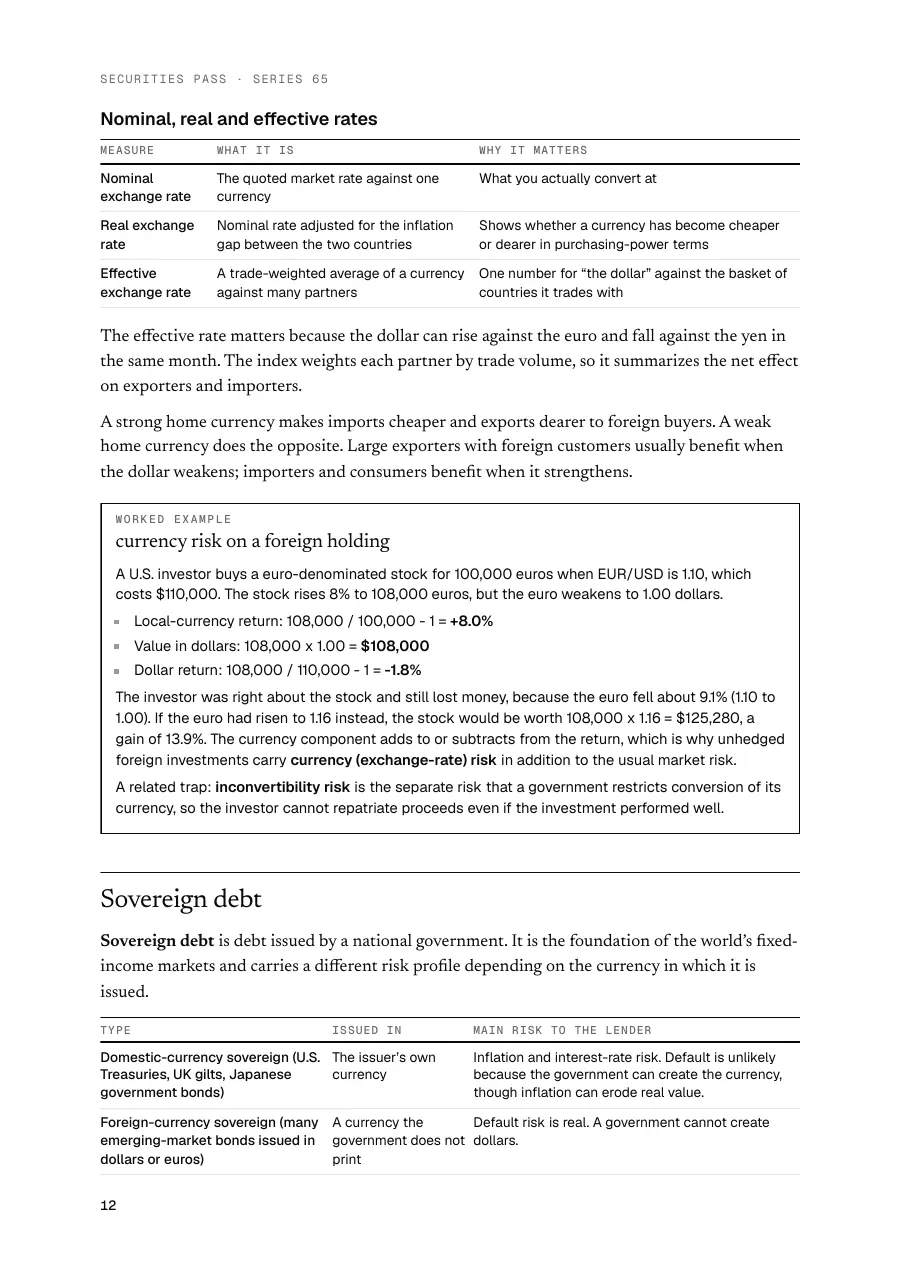
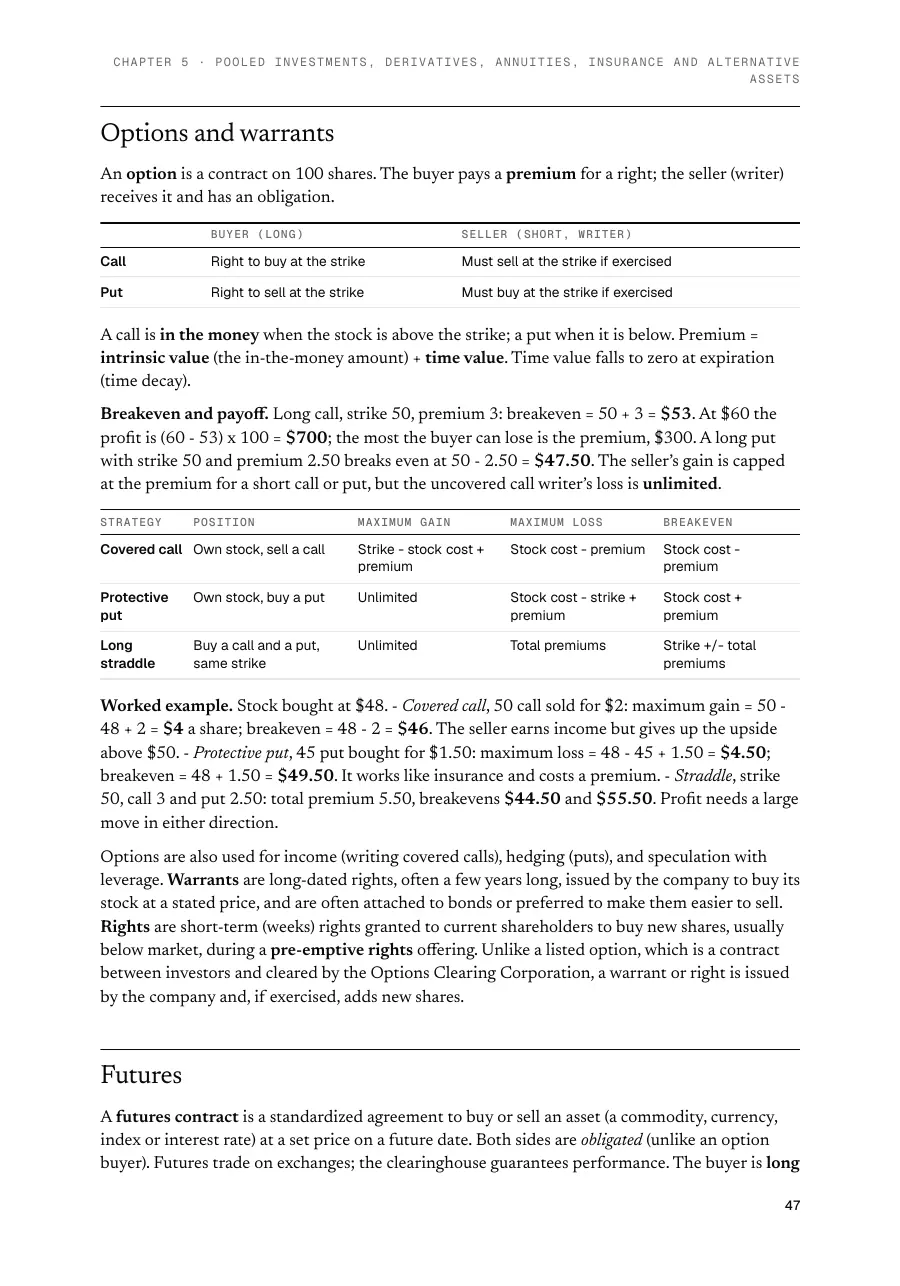

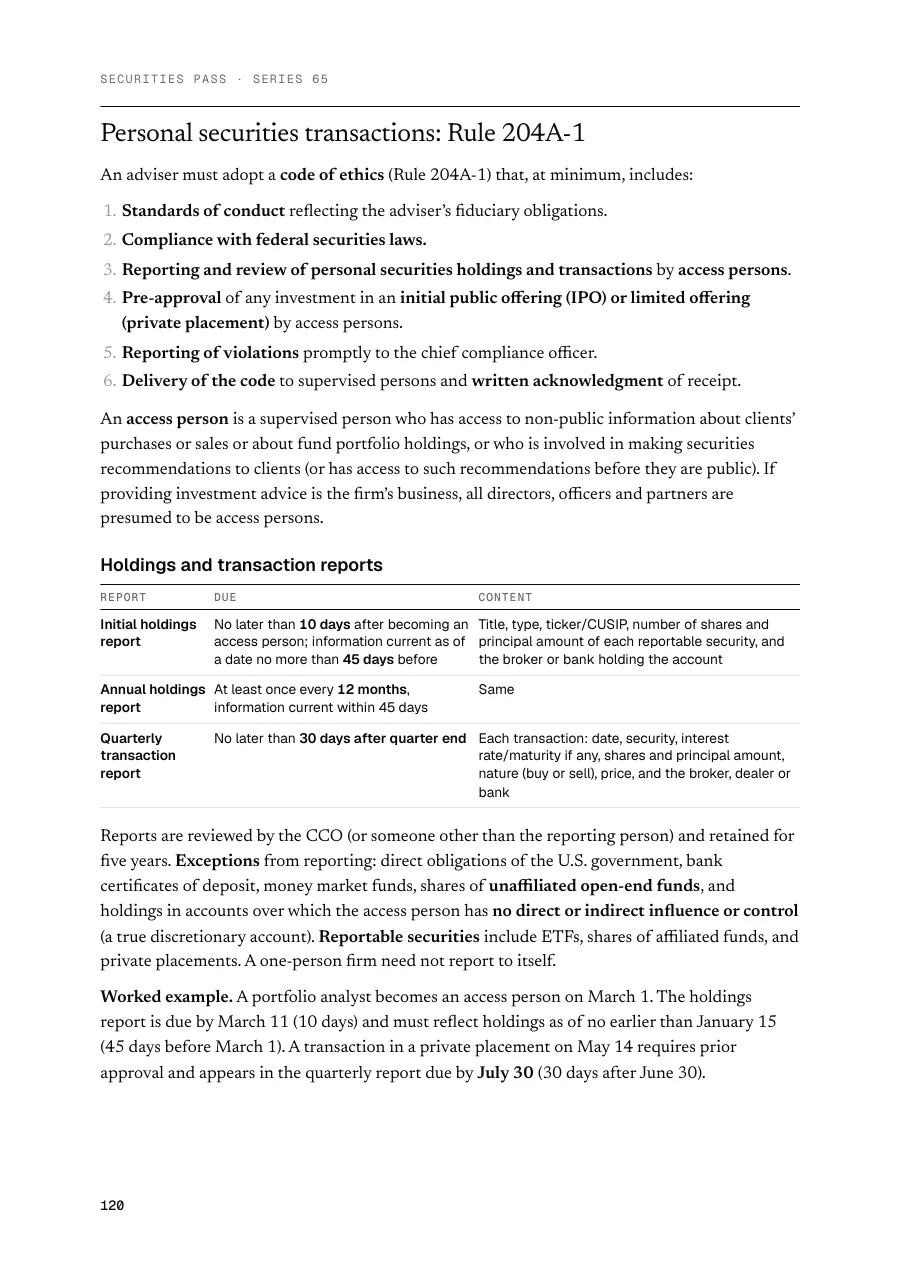

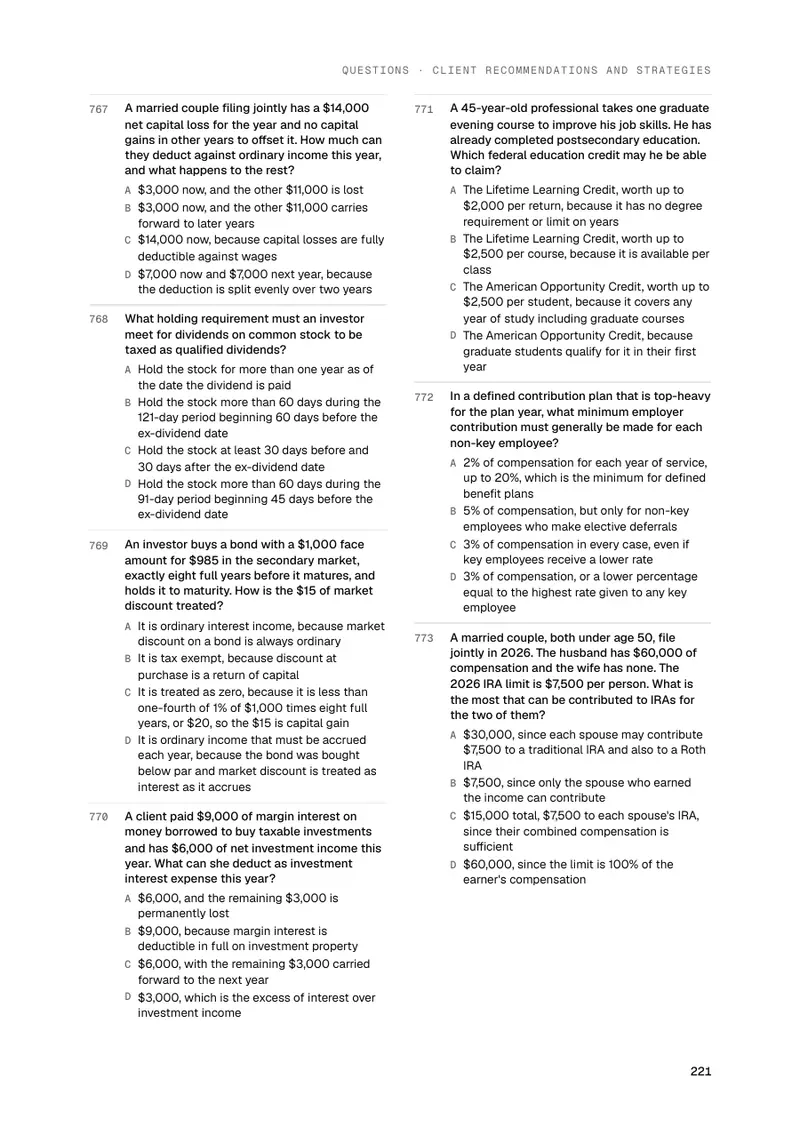
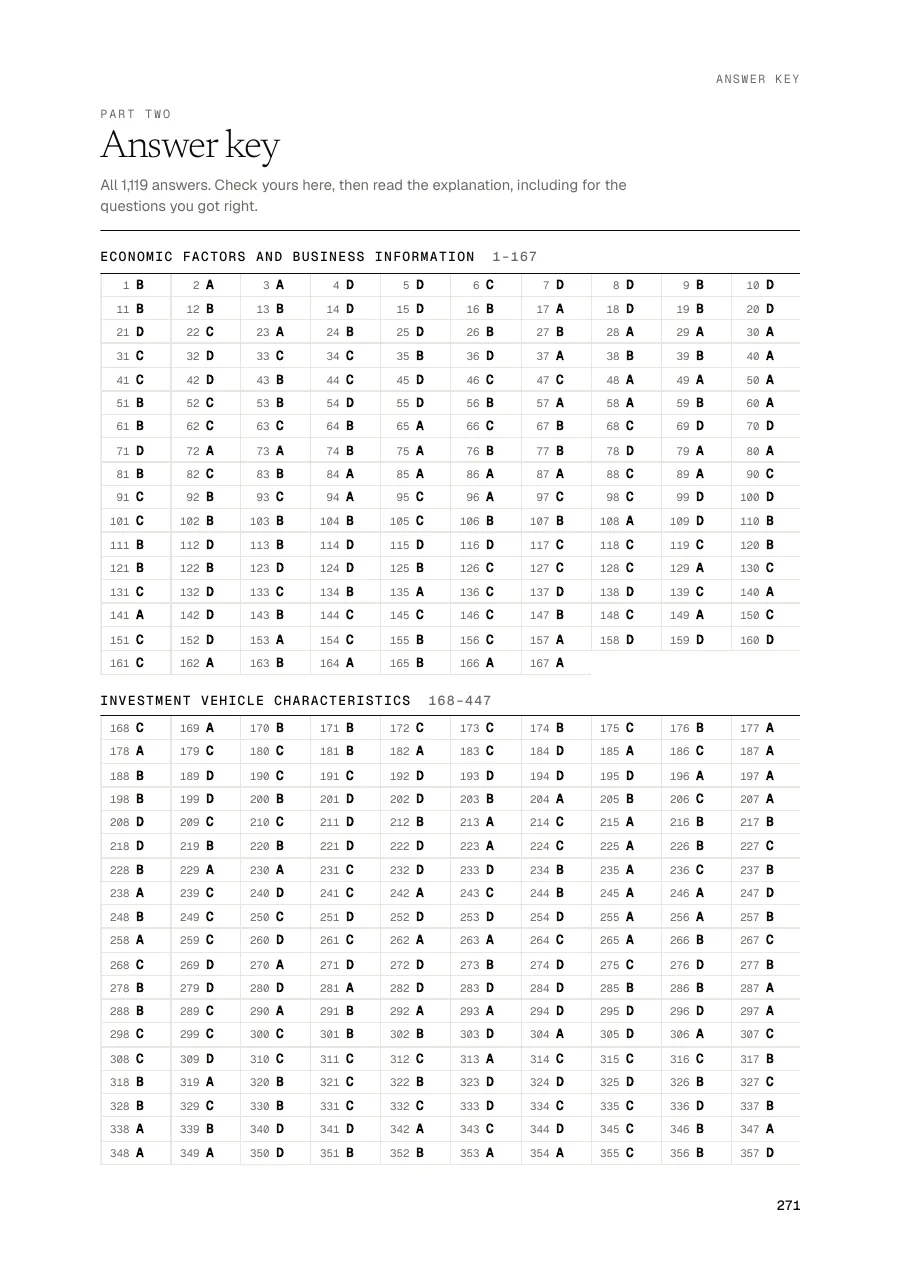
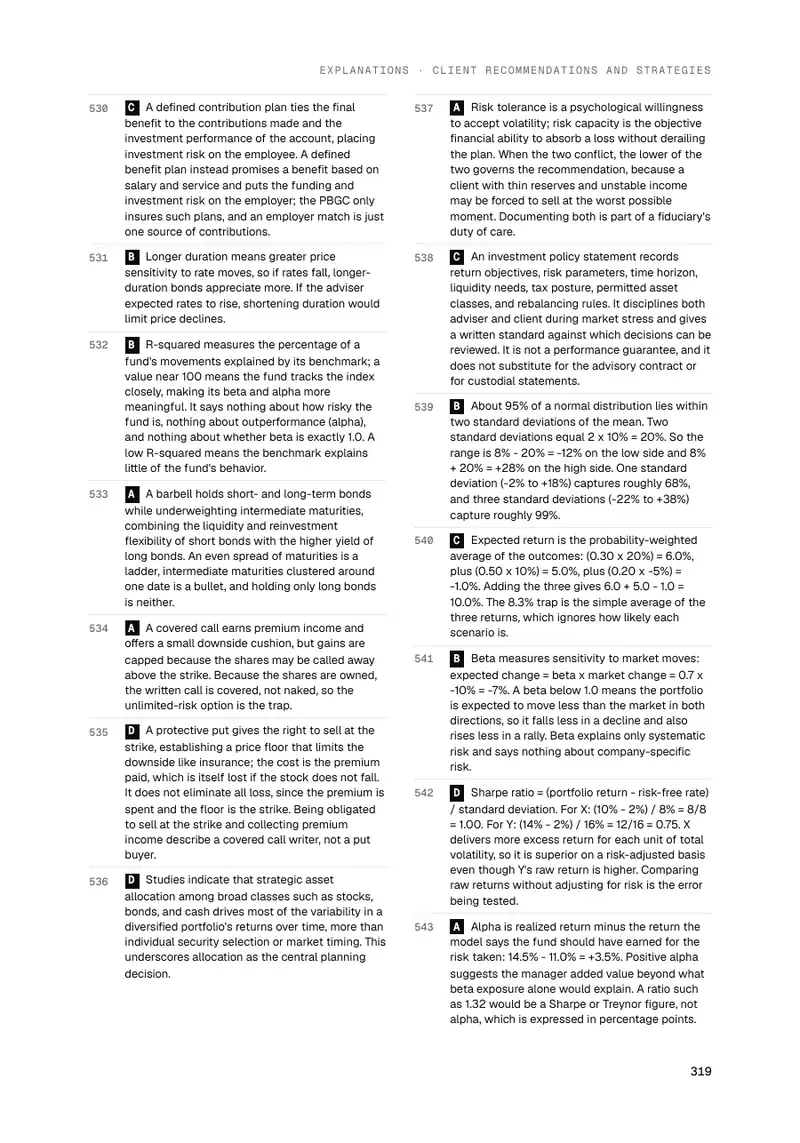
Free sample chapter
Chapter 2, as it appears in the book. No download and no email.
The outline asks you to read the three financial statements, understand how audited reports and SEC filings reach investors, compute common ratios and statistics, and apply discounted-cash-flow logic. This chapter teaches those tools with one running company so the numbers tie together.
The three statements, using one company
Harbor Tools is a small public company. All figures are in millions of dollars except per-share data.
Income statement (for the year)
| Line | Amount |
|---|---|
| Revenue | 5,000 |
| Cost of goods sold | 3,000 |
| Gross profit | 2,000 |
| Selling, general and administrative | 850 |
| Depreciation | 200 |
| Operating income (EBIT) | 950 |
| Interest expense | 150 |
| Pre-tax income | 800 |
| Taxes at 25% | 200 |
| Net income | 600 |
| Shares outstanding | 200 million |
| Earnings per share (EPS) | $3.00 |
The statement runs top to bottom from sales to what is left for owners. Margins follow: gross margin 2,000 / 5,000 = 40%; operating margin 950 / 5,000 = 19%; net margin 600 / 5,000 = 12%. Depreciation is a non-cash expense: it lowers reported income but no cash leaves the company that year.
Balance sheet (at year end)
| Assets | Liabilities and equity | ||
|---|---|---|---|
| Cash | 300 | Accounts payable | 400 |
| Accounts receivable | 500 | Short-term debt | 200 |
| Inventory | 700 | Current liabilities | 600 |
| Current assets | 1,500 | Long-term debt | 1,200 |
| Property, plant and equipment (net) | 2,000 | Total liabilities | 1,800 |
| Paid-in capital | 700 | ||
| Retained earnings | 1,000 | ||
| Shareholders' equity | 1,700 | ||
| Total assets | 3,500 | Total liabilities and equity | 3,500 |
The identity that must always hold: assets = liabilities + shareholders' equity. Here 3,500 = 1,800 + 1,700. A balance sheet is a snapshot on one date; an income statement covers a period.
Current assets are those expected to turn into cash within a year; current liabilities fall due within a year.
Statement of cash flows
The cash-flow statement reconciles net income to the change in cash. Accrual accounting earns revenue before the cash arrives, so net income and cash flow differ.
| Section | Items | Amount |
|---|---|---|
| Operating | Net income 600 + depreciation 200 - increase in receivables 40 - increase in inventory 30 + increase in payables 20 | 750 |
| Investing | Purchase of equipment | -300 |
| Financing | Dividends -100, repayment of debt -150 | -250 |
| Net change in cash | 750 - 300 - 250 | +200 |
(Check: 750 - 300 - 250 = 200.) Three sections to remember: operating cash comes from running the business, investing is buying or selling long-term assets, and financing is dealing with lenders and shareholders. A company reporting profit but negative operating cash flow for several years deserves skepticism; sales on credit may not be collected, or inventory may be piling up.
Accrual versus cash accounting
| Cash basis | Accrual basis | |
|---|---|---|
| Revenue recorded | When cash is received | When earned, whether or not paid |
| Expense recorded | When cash is paid | When incurred, matched to the revenue it helps produce |
| Used by | Many small businesses and individuals | All public companies (U.S. GAAP requires it) |
| Weakness | Timing of payments distorts results | Reported profit may not equal cash |
Example: a firm ships goods in December for $10,000 and is paid in January. Accrual accounting books the $10,000 in December; cash accounting books it in January. If it pays a $4,000 insurance premium in December for the next year, cash accounting expenses it all in December; accrual spreads it across the year it covers.
Audited and unaudited statements, and auditor opinions
Audited statements have been examined by an independent public accounting firm that tests the records and issues an opinion on whether the statements fairly present the company's position under GAAP. Unaudited statements (including most quarterly figures in a 10-Q, which are reviewed rather than audited) carry no such opinion. Public companies must have annual statements audited by a firm registered with the Public Company Accounting Oversight Board (PCAOB), created by the Sarbanes-Oxley Act of 2002. Sarbanes-Oxley also requires the CEO and CFO to certify the reports.
| Opinion | Meaning |
|---|---|
| Unqualified ("clean") | The statements are fairly presented in all material respects. This is the normal, best result. |
| Qualified | Fair, except for a specific matter (a departure from GAAP or a limit on the audit's scope). |
| Adverse | The statements are materially misstated and do not fairly present the company. |
| Disclaimer of opinion | The auditor could not gather enough evidence and gives no opinion. |
An unqualified opinion is not a guarantee of the company's quality or of the absence of fraud. It says the statements are not materially misstated. An auditor may add an explanatory paragraph (for example, "substantial doubt about the company's ability to continue as a going concern"), which an investor should treat as a serious warning even when the opinion is otherwise unqualified.
Corporate SEC filings and the annual report
| Document | Content | Timing |
|---|---|---|
| Form 10-K | Audited annual report: business description, risk factors, management discussion and analysis (MD&A), audited statements | 60 days after year end for large accelerated filers, 75 days for accelerated filers, 90 days for all others |
| Form 10-Q | Unaudited quarterly statements and MD&A, filed for the first three quarters | 40 days after quarter end for large accelerated and accelerated filers, 45 days for all other filers |
| Form 8-K | Current report of material events: acquisitions, bankruptcy, executive departures, earnings releases | Generally within four business days of the event |
| Proxy statement (DEF 14A) | Sent before the annual meeting: director elections, executive pay, shareholder proposals | Before the vote |
| Annual report to shareholders | Glossy report, required to accompany the proxy statement for the annual meeting; contains the financial statements and letter from management | With the proxy |
Related filings that identify insider activity: Form 4 (officers, directors and 10% holders report trades within two business days) and Schedule 13D/13G (ownership over 5%). The 10-K is the legal document; the annual report to shareholders is the marketing version of the same facts. Investors find all of these free on the SEC's EDGAR database.
Capital structure and who gets paid first
The capital structure is the mix of debt and equity that finances the company. In liquidation, claims are paid in strict order of priority, and a senior class must be paid in full before the next receives anything:
- Secured creditors (from their collateral)
- Administrative costs, wages and taxes (statutory priority claims)
- General unsecured creditors, including debenture holders and trade creditors (equal rank, paid pro rata)
- Subordinated debt
- Preferred stockholders
- Common stockholders (residual owners)
Worked example — a liquidation waterfall
Harbor's assets are liquidated for $2,600. Claims: secured bank loan 1,000; unsecured (payables 400 plus debentures 800) 1,200; subordinated debentures 300; preferred stock 200 (par); common stock the rest.
| Step | Pays | Remaining |
|---|---|---|
| Start | 2,600 | |
| Secured creditors | 1,000 | 1,600 |
| Unsecured creditors (1,200 owed) | 1,200 | 400 |
| Subordinated debt (300 owed) | 300 | 100 |
| Preferred (200 owed) | 100 (50 cents on the dollar) | 0 |
| Common | 0 | 0 |
Common holders receive nothing. Had proceeds been only 2,000, the unsecured class would have received 1,000 of 1,200 (83.3 cents per dollar, split pro rata between payables and debentures) and nothing below them. This is why equity carries more risk than debt, and why common stock needs a higher expected return.
Leverage cuts both ways. Debt costs a fixed interest charge; if business is good, owners keep the surplus, and if bad, the fixed charge still must be paid.
Liquidity, leverage and valuation ratios
All use Harbor's figures.
| Ratio | Formula | Calculation | Result | Reads as |
|---|---|---|---|---|
| Current ratio | Current assets / current liabilities | 1,500 / 600 | 2.50 | Can short-term obligations be covered |
| Quick (acid-test) ratio | (Current assets - inventory) / current liabilities | (1,500 - 700) / 600 | 1.33 | Tougher test; inventory is the slowest asset to turn into cash |
| Debt-to-equity | Total liabilities / equity (some sources use interest-bearing debt only) | 1,800 / 1,700 | 1.06 | Leverage. Using debt only: (200 + 1,200) / 1,700 = 0.82 |
| Interest coverage | EBIT / interest | 950 / 150 | 6.33 | Margin of safety for lenders |
| Return on equity | Net income / equity | 600 / 1,700 | 35.3% | Profit per dollar of owners' capital |
| EPS | Net income / shares | 600 / 200 | $3.00 | |
| Book value per share | Equity / shares | 1,700 / 200 | $8.50 | |
| P/E | Price per share / EPS | 45 / 3.00 | 15.0 | Dollars paid per dollar of earnings |
| P/B | Price per share / book value per share | 45 / 8.50 | 5.29 | Price relative to accounting net worth |
Notes:
- A quick ratio below 1.0 suggests the company could not meet current liabilities without selling inventory or borrowing.
- A high P/E means the market expects growth or sees low risk; a low P/E can mean cheap or troubled. Compare within an industry, not across industries. The earnings yield is the inverse: 3.00 / 45 = 6.7%.
- P/B below 1.0 means the market values the company below its recorded net worth (a possible bargain, or a sign the assets are worth less than carried). P/B is most useful for banks, insurers and other asset-heavy firms; it is poor for firms whose value lies in intangibles.
- Two firms with the same debt-to-equity can differ widely in risk if one has volatile earnings. Always read leverage with coverage.
Try the questions first, free. The Series 65 quick check is ten questions and takes about five minutes. It ranks your topics worst-first, so you can see what you would be paying to fix.
Take the quick checkAbout the exam itself
| Administering body | North American Securities Administrators Association (NASAA) — exam delivered by FINRA Source: FINRA — Series 65 – Uniform Investment Adviser Law Exam |
|---|---|
| Questions | 140 questions (130 scored, 10 unscored pretest) |
| Time limit | 180 minutes |
| Passing score | 92 of 130 correct |
| Fees |
|
| Languages offered | English |
What’s included, and what isn’t
Included
- Series 65 study guide as a PDF and an EPUB, 373 pages
- 14 chapters, in teaching order
- 1,119 practice questions in the book, grouped by topic, with answers and explanations
Not included
- The online practice questions and timed mock exams. They stay free on this site and are not part of the download.
- The cheat sheet. It is a separate product, also sold with this one as a bundle.
- A printed copy. Delivery is a download; the PDF prints.
- A pass guarantee. The refund covers satisfaction with the file, not exam results.
- Registration for the exam. That goes through the exam administrator.
Why buy the guide when practice is free?
The practice questions and the timed mock exam are free. The $24.99 guide is the studying half: the material itself, taught in order, in a file you own, with 1,119 practice questions and explanations printed in the back.
Before you buy
- Delivery is an instant download after payment. Lost the email? Use Find my purchase and we send the links again.
- Use the PDF for print and the EPUB for a phone or e-reader.
- Read the free sample chapter above first. It is exactly how the book is written.
- 14-day money-back guarantee, for any reason. Details on the refund page.
- Rules, fees and figures change. Confirm current requirements with the exam administrator before exam day.
- If you want the guide and the cheat sheet for this exam, the bundle costs less than buying both. See the buy box.
The details
| Product | Study guide |
| Exam | Series 65, Uniform Investment Adviser Law |
| Edition | 2026 |
| Format | PDF + EPUB |
| Length | 373 pages |
| Chapters | 14 |
| Practice questions in the book | 1,119 |
| Price | $24.99, one payment |
| Refund window | 14 days |
| File last updated | November 2026 |
Questions buyers ask
Is a study guide enough for the Series 65 — Uniform Investment Adviser Law Examination exam, or do I need a course?
A book is exam review: it does not replace any education, training or experience North American Securities Administrators Association (NASAA) requires before you may sit the exam, so check those requirements first. For the exam content itself, this 373-page guide teaches the material chapter by chapter with 1,119 practice questions and explanations inside, all of them in a question bank grouped by topic. A prep course adds live instruction and a set schedule; whether you need one beyond any required education is your call.
What is the cheapest way to prepare for the Series 65 — Uniform Investment Adviser Law Examination exam?
Start with what costs nothing: 1,119 practice questions on Securities Pass, with explanations and no signup. If you want it taught in one file you keep, the full study guide is $24.99 once. No subscription on any of them.
Who administers the Uniform Investment Adviser Law Examination (Series 65)?
North American Securities Administrators Association (NASAA) — exam delivered by FINRA. The Series 65 is a NASAA exam administered by FINRA. FINRA states the exam is available online only for candidates who require a testing accommodation; everyone else takes it at a test center. An unsponsored candidate opens an enrollment window through FINRA rather than filing a Form U4, and FINRA then allows 120 days in which to schedule and sit the exam.
How many questions are on the Uniform Investment Adviser Law Examination (Series 65)?
140 questions (130 scored, 10 unscored pretest). A candidate sees 140 questions and is graded on 130 of them: NASAA states the exam "consists of 130 questions plus 10 pretest questions", and FINRA states the same split as "130 scored questions and 10 unscored questions". FINRA's own at-a-glance box lists "Number of Items 130", which is the scored count, not the number of questions on the paper — so both 140 and 130 are correct answers to different questions and neither should be quoted alone.
How long is the Uniform Investment Adviser Law Examination (Series 65)?
180 minutes. NASAA allows 180 minutes for the whole exam, FINRA states the same duration, and neither publishes a separate per-question or per-section limit.
What is the passing score for the Uniform Investment Adviser Law Examination (Series 65)?
92 of 130 correct. 92 of the 130 scored questions. NASAA's Exam FAQ answers the question "Why did I receive a 'fail' … even though I scored a 70%?" directly: "The passing grade for the Series 65 exam is not 70% and is not calculated as a percentage." The 10 pretest questions are not part of the denominator, so a percentage computed over 140 is wrong twice over. Securities Pass states the raw rule and no percentage.
How much does the Uniform Investment Adviser Law Examination (Series 65) cost?
$187 — Examination fee (FINRA, per attempt). The fee is paid to FINRA when the enrollment window is opened, and NASAA's Exam FAQ lists it alongside the other two NASAA exams: $147 for the Series 63, $187 for the Series 65, $177 for the Series 66. FINRA's Series 65 page shows the same $187. Neither body publishes a separate retake fee, so a retake is a new enrollment at the same price.
What languages is the Uniform Investment Adviser Law Examination (Series 65) offered in?
English. English only. NASAA answers it outright: “No, NASAA exams are only available in English.” A candidate whose primary language is not English may request additional testing time under FINRA's Limited English Proficiency policy — extra time on the English exam, not a translated one.
Does the Series 65 — Uniform Investment Adviser Law Examination study guide come as a PDF?
Yes — Series 65 Study Guide (2026) downloads as PDF and EPUB, 373 pages. The download link is emailed the moment payment clears and does not expire.
How much does the Series 65 — Uniform Investment Adviser Law Examination study guide cost?
$24.99, once. There is no subscription and no account to create; the PDF and EPUB files are yours to keep.
Are there free Series 65 — Uniform Investment Adviser Law Examination practice questions?
Yes — 1,119 of them, free to use with no signup and an explanation on every one. This study guide has 1,119 practice questions with answers and explanations. The same free, no-account system also has practice modes (adaptive, new questions, spaced review of misses, weak-topic focus, saved, my mistakes); a timed mock exam (130 questions, 180 minutes) with a score report by topic; a 10-question readiness check (about 5 minutes); 4 study chapters; a day-by-day study plan. None of it needs this study guide.
Can I read part of the Series 65 — Uniform Investment Adviser Law Examination study guide before buying?
Yes. A full chapter is free to read on this page — not a summary of one, the chapter itself.
Is there a cheaper way to buy the Series 65 — Uniform Investment Adviser Law Examination study guide with anything else?
Yes. Series 65 Study Guide + Cheat Sheet (Securities Pass) is $29.99 for 2 files in one checkout — 14% less than the $34.98 those items cost bought separately today. It adds Series 65 — Cheat Sheet (2026). The saving is measured against the items' real current prices; there is no struck-through "original" price on this site.
Is this the official Series 65 — Uniform Investment Adviser Law Examination study guide?
No. This is an independent study guide and is not affiliated with or endorsed by the exam's awarding body. It is written from NASAA content outline / SEC, FINRA and state rules — source-checked. Always confirm current requirements with the body that issues your licence.
Related free resources
- Series 65 exam pageFacts and sources
- Free Series 65 practice questionsExplained
- Series 65 quick check10 questions
- Series 65 timed mock examFree
- Browse every Series 65 questionAnswers showing
- Series 65 topicsLearn by area
- Series 65 30-day study planFree schedule
- Free Series 65 cheat sheet, on screenPrintable
- How hard is the Series 65?Difficulty
- Series 65 pass rate and retakesWhat is published
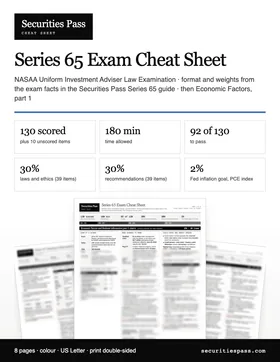
The cheat sheet for this exam
Independent study material, not affiliated with or endorsed by FINRA, the SEC, NASAA or any test-delivery vendor. Rules and figures change; confirm current requirements with NASAA before exam day.
Independent study materials. Not affiliated with, endorsed by or sponsored by FINRA, the SEC or NASAA. Exam names are used only to say which exam a product prepares for.
File last updated November 2026.