- Length
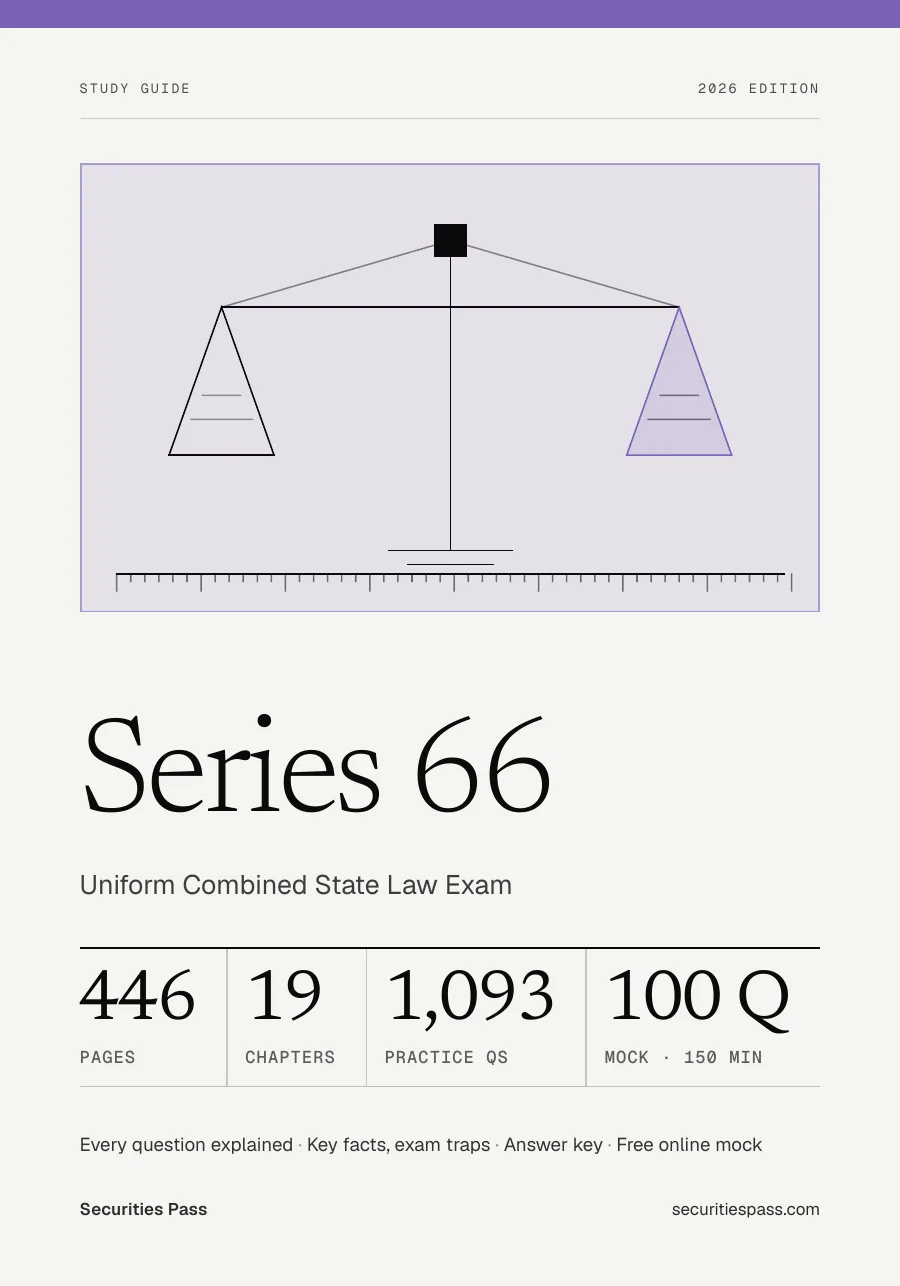
- 446 pages
- Practice questions
- 1,093
- Mock · 150 min
- 100 Q
Study guide · 2026 edition
Series 66 Study Guide (2026)
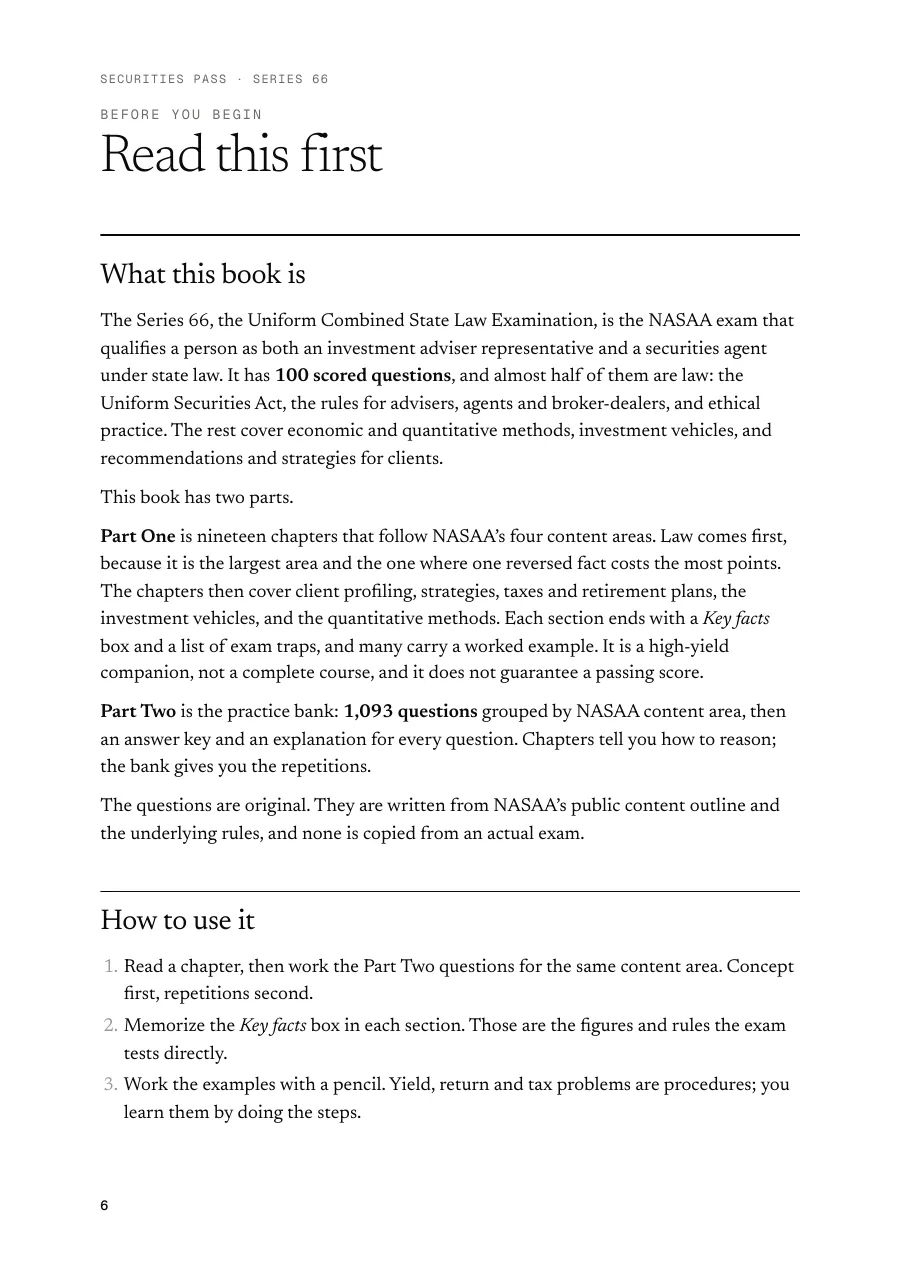
Written chapter by chapter for the Series 66 exam, with every practice question explained and the working shown.
- Format
- PDF + EPUB
- Length
- 446 pages
- Practice questions in the book
- 1,093
- File last updated
- October 2026
- Delivery
- Instant download after payment
Your options for this exam
- Study guide$24.99You are looking at this one
- Cheat sheet$9.99See what is inside
- BundleGuide + cheat sheet$29.99Save $4.99 vs buying separately
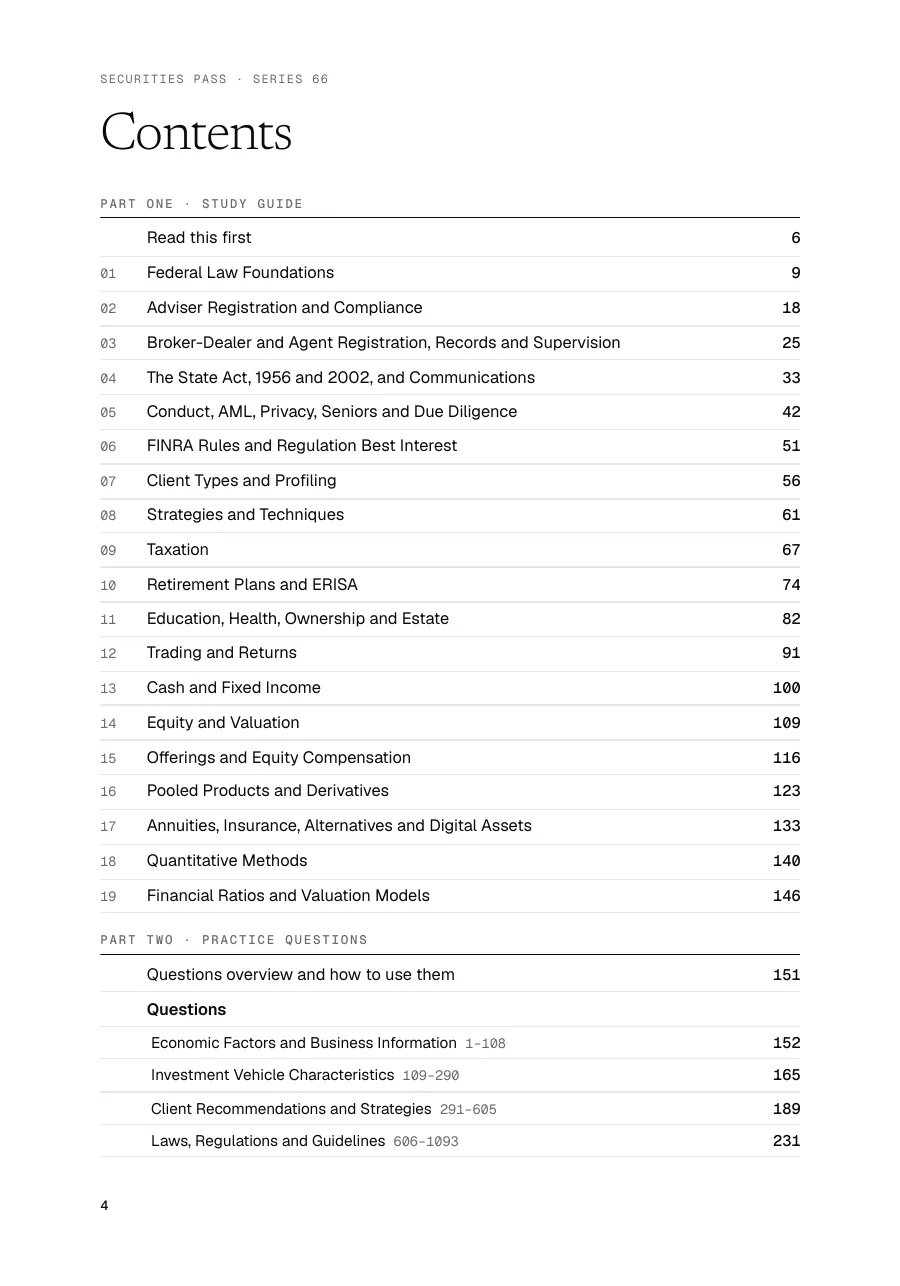
Contents
| Ch. | Chapter |
|---|---|
| 01 | Federal Law Foundations |
| 02 | Adviser Registration and Compliance |
| 03 | Broker-Dealer and Agent Registration, Records and Supervision |
| 04 | The State Act, 1956 and 2002, and Communications |
| 05 | Conduct, AML, Privacy, Seniors and Due Diligence |
| 06 | FINRA Rules and Regulation Best Interest |
| 07 | Client Types and Profiling |
| 08 | Strategies and Techniques |
| 09 | Taxation |
| 10 | Retirement Plans and ERISA |
| 11 | Education, Health, Ownership and Estate |
| 12 | Trading and Returns |
| 13 | Cash and Fixed Income |
| 14 | Equity and Valuation |
| 15 | Offerings and Equity Compensation |
| 16 | Pooled Products and Derivatives |
| 17 | Annuities, Insurance, Alternatives and Digital Assets |
| 18 | Quantitative Methods Free sample |
| 19 | Financial Ratios and Valuation Models |
Chapter numbers are those printed in the book.
What’s inside
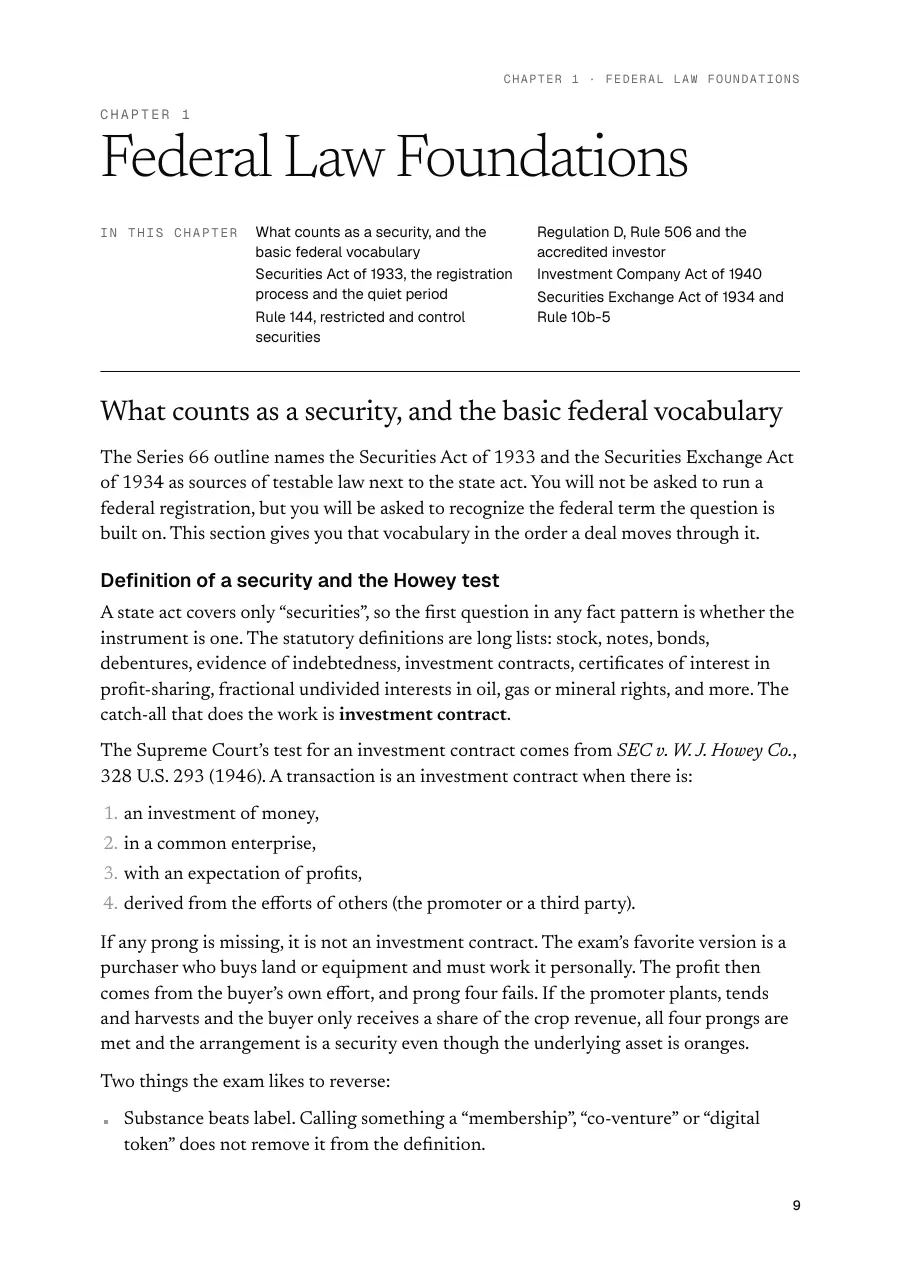
- Chapters in teaching order, written to the Series 66 content outline
- A question bank of 1,093 practice questions, grouped by topic, with answers and explanations
- Worked examples where the exam asks for arithmetic, and the traps named where candidates miss
- PDF (print and tab it) + EPUB (phone or e-reader)
Look inside
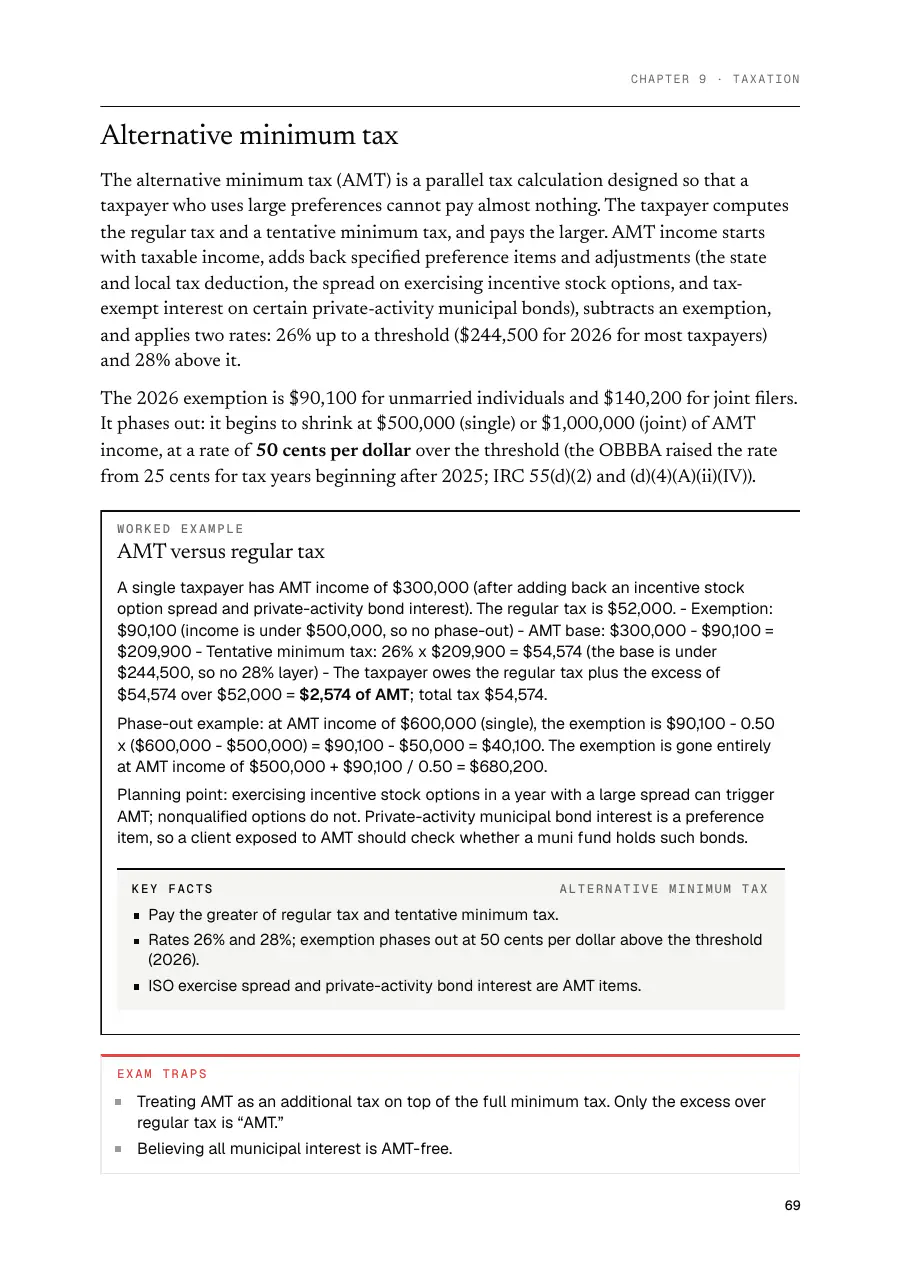
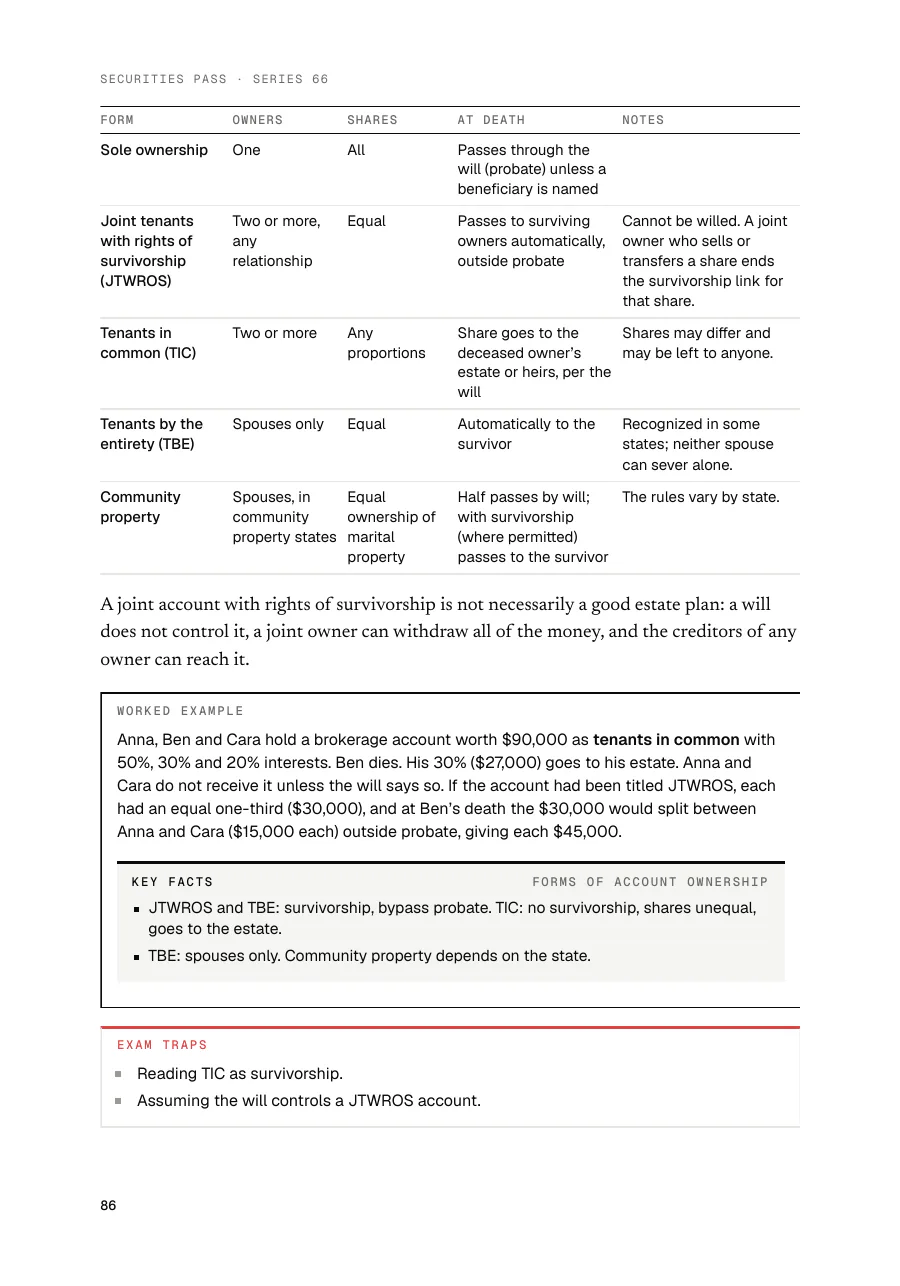
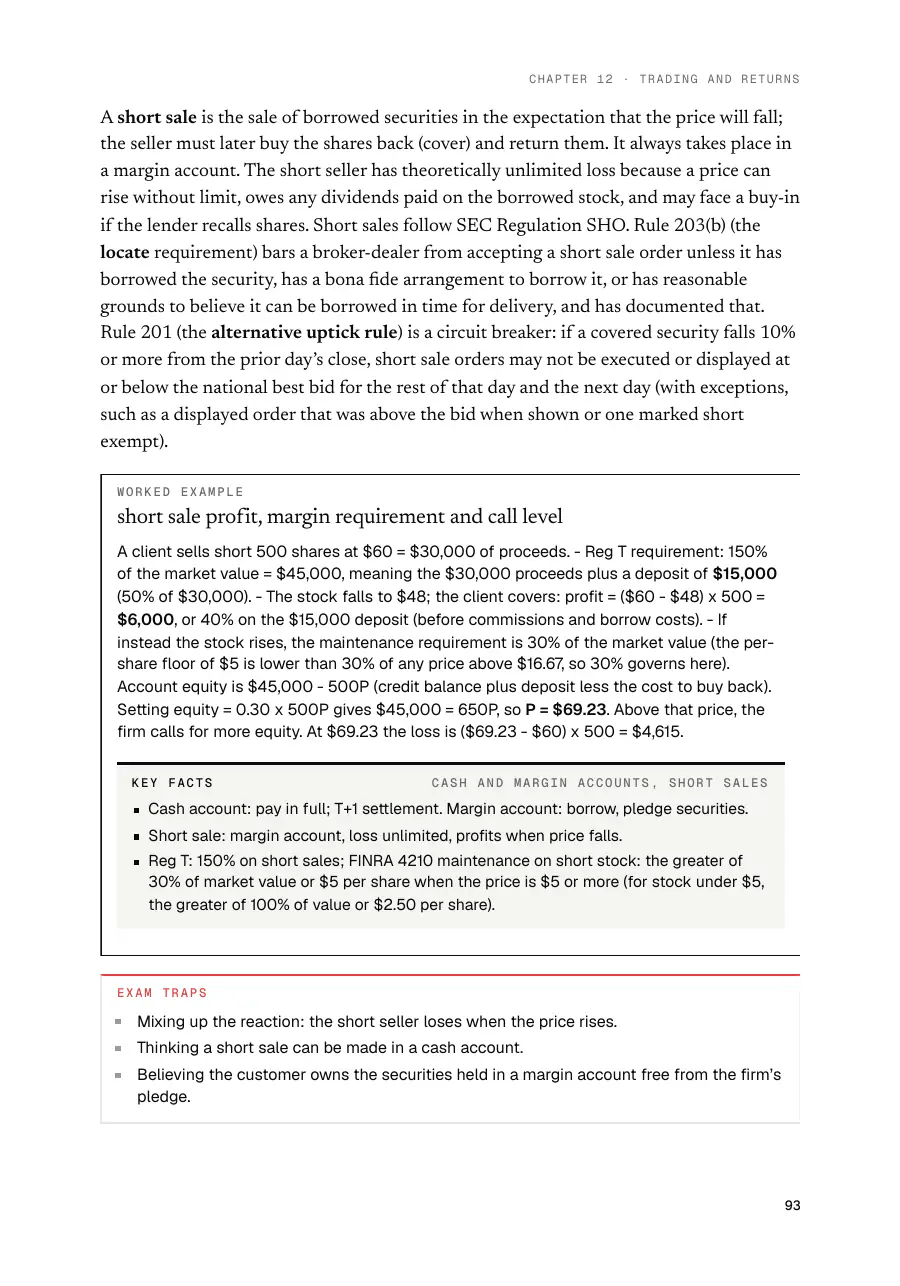
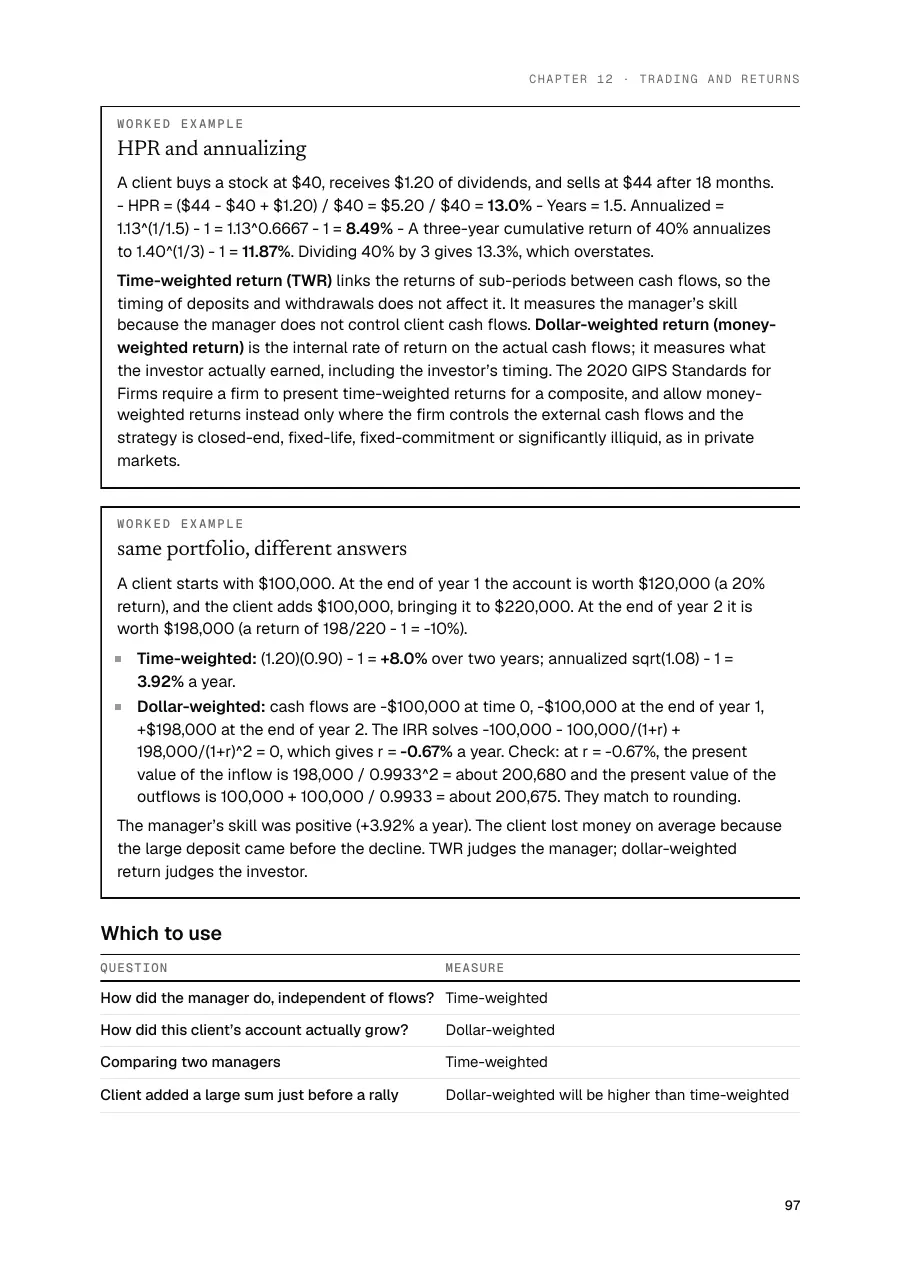
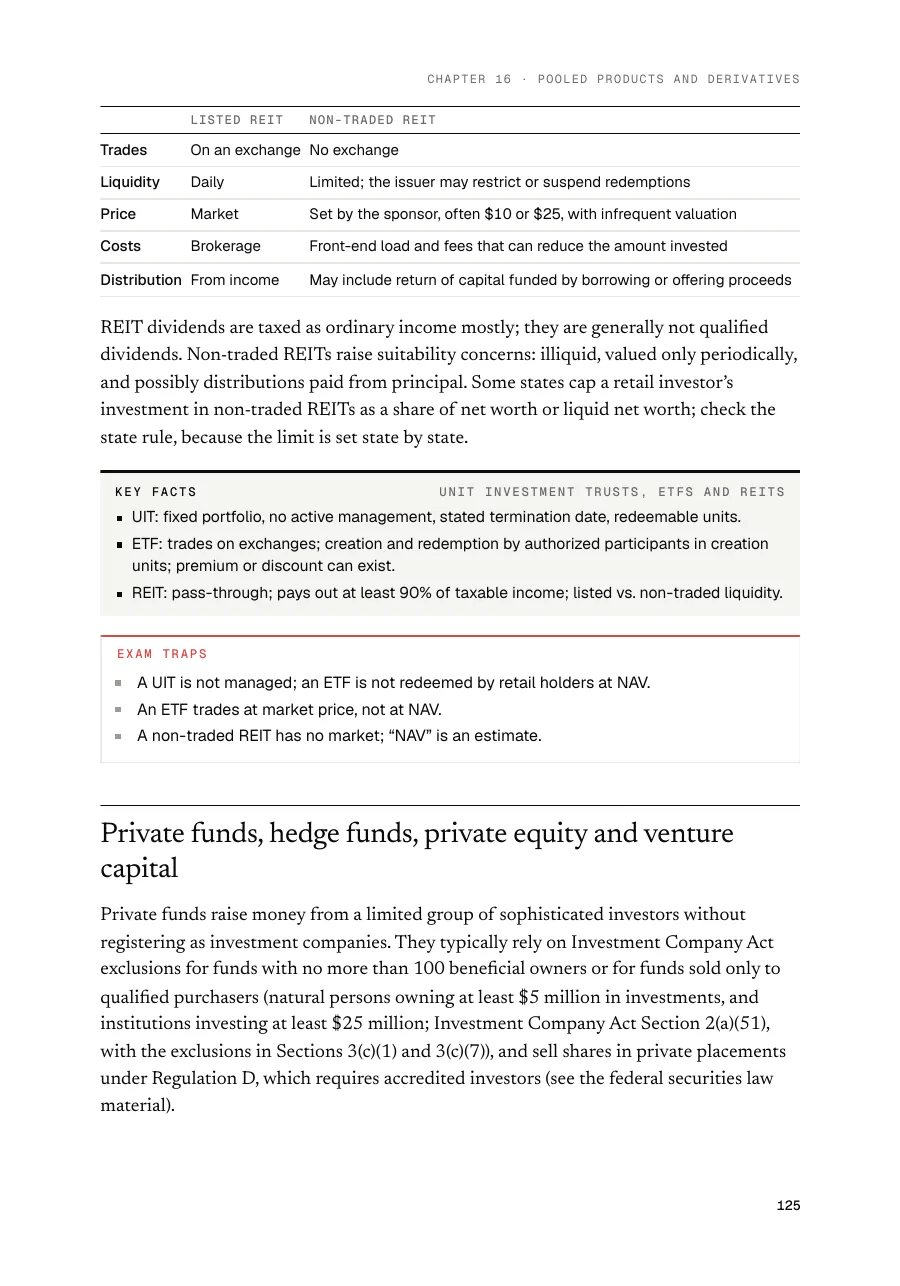
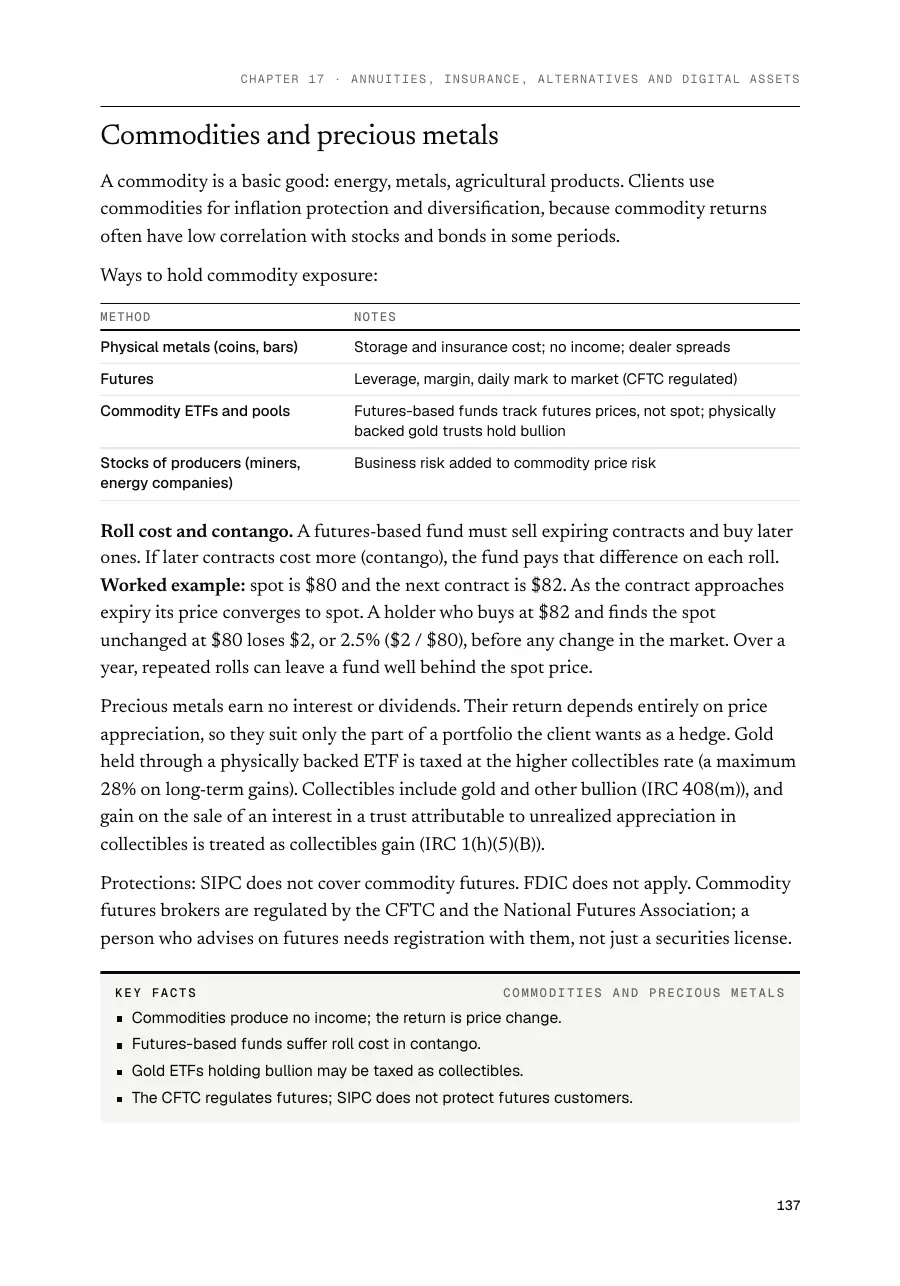
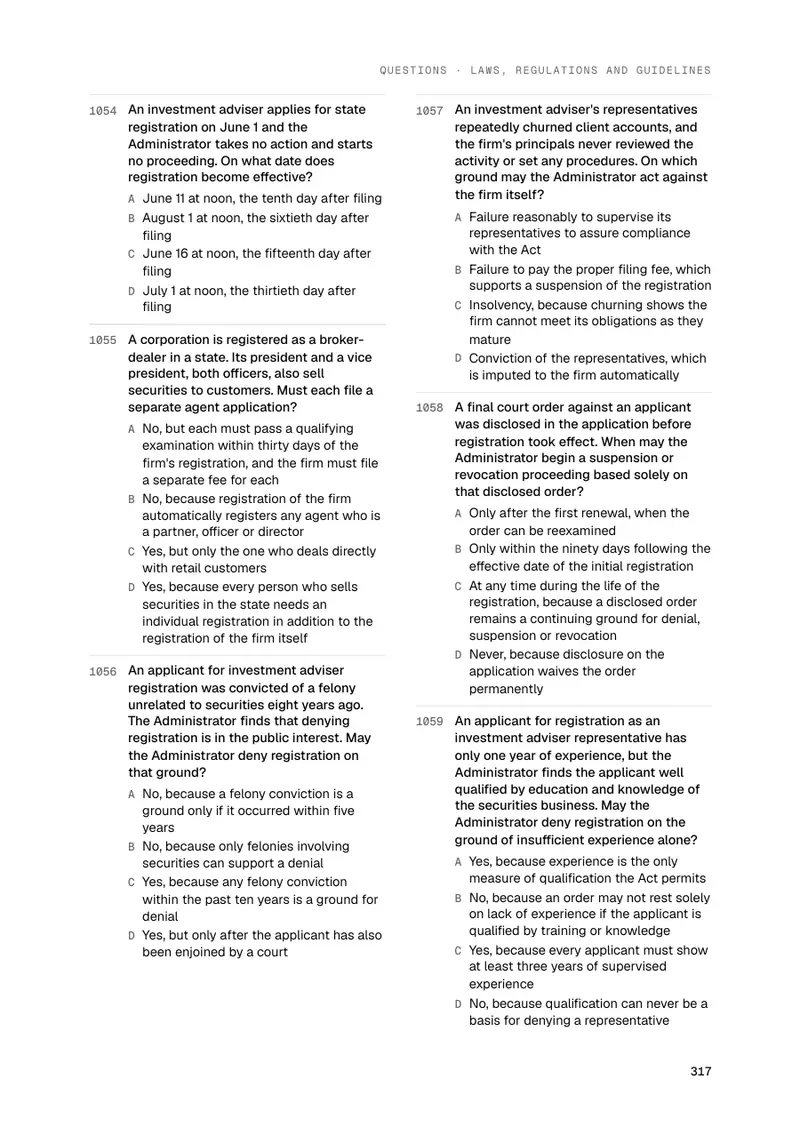
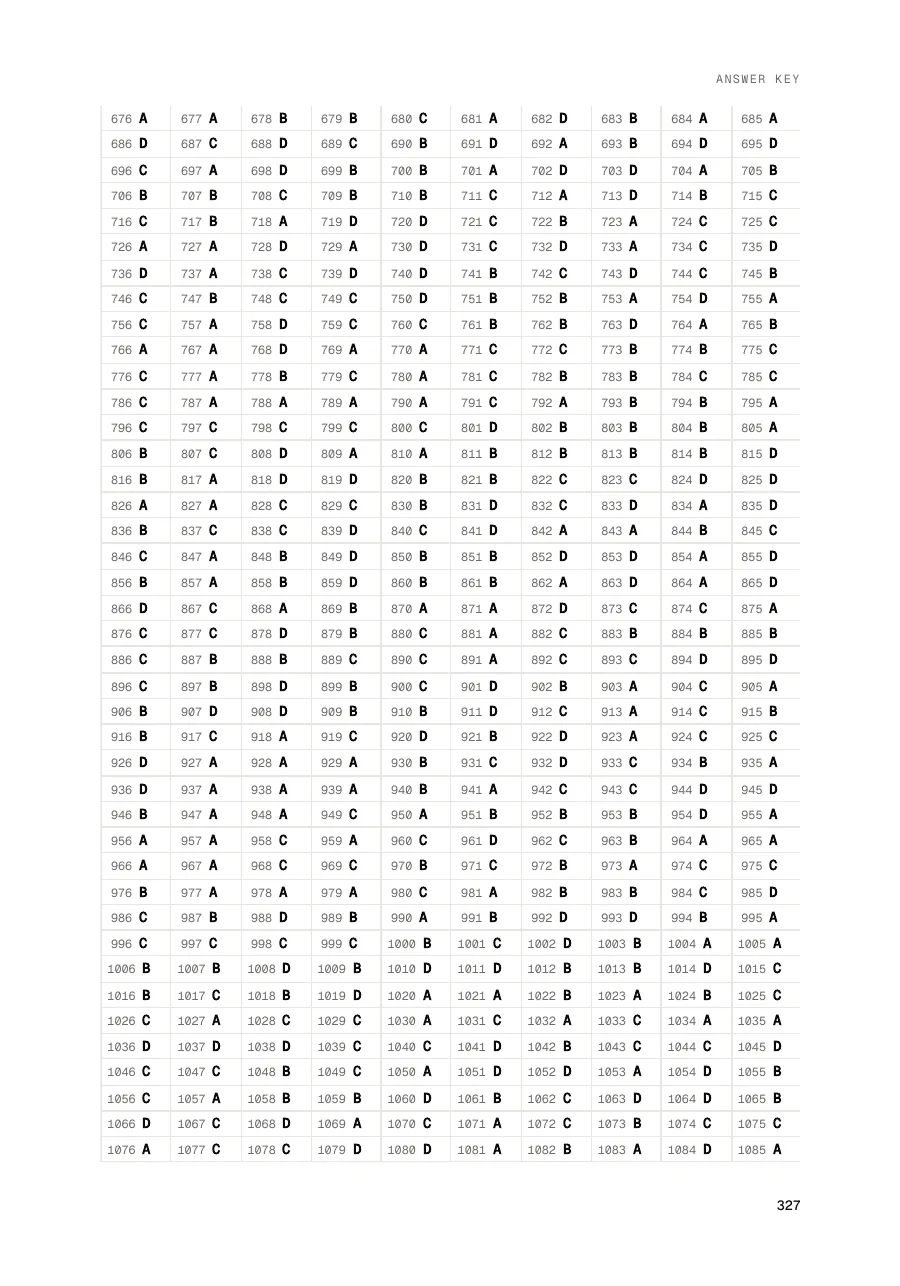
14 pages of the Series 66 guide, exactly as printed. Swipe, or use the arrow keys.

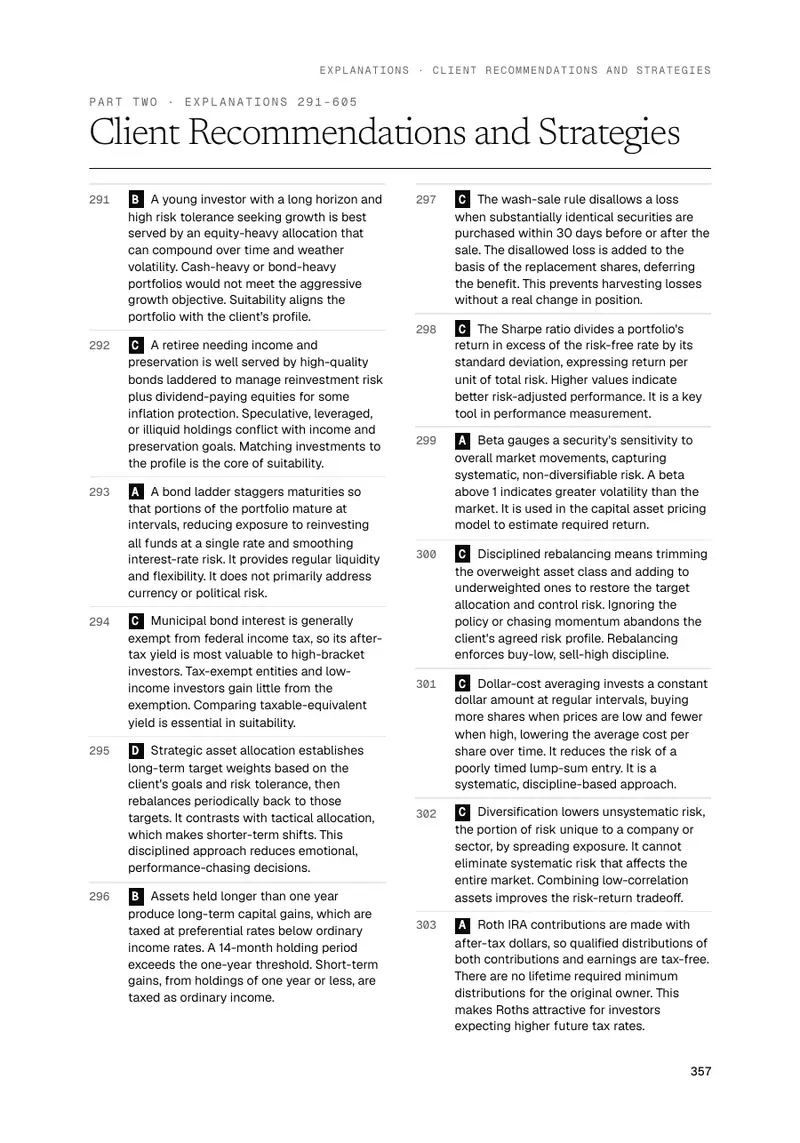
Free sample chapter
Chapter 18, as it appears in the book. No download and no email.
Time value of money: future value, present value, NPV and IRR
Money received sooner is worth more than money received later, because it can be invested. All the formulas below use one idea: moving a dollar amount across time at a rate of return.
Future value
FV = PV x (1 + r)^n
Worked example. $10,000 invested at 6% a year for 8 years: $10,000 x 1.06^8 = $10,000 x 1.5938 = $15,938.48.
If interest compounds quarterly the rate per period is 6% / 4 = 1.5% and there are 8 x 4 = 32 periods: $10,000 x 1.015^32 = $16,103.24. More frequent compounding gives a larger amount.
Rule of 72. Years to double is about 72 divided by the annual rate in percent. At 6%, 72 / 6 = 12 years. Check: $10,000 x 1.06^12 = $20,121.96. The rule is an approximation that works best between 6% and 10%.
Present value
PV = FV / (1 + r)^n
Worked example. A client wants $20,000 in 5 years and can earn 7%. PV = $20,000 / 1.07^5 = $20,000 / 1.4026 = $14,259.72. The client needs $14,259.72 today.
Present value of a series. To receive $1,000 at the end of each year for 5 years with a 6% discount rate, discount each payment: $943.40 + $890.00 + $839.62 + $792.09 + $747.26 = $4,212.36.
A higher discount rate gives a lower present value; a longer time gives a lower present value.
Net present value
NPV is the sum of the present values of all cash flows, including the initial outlay, discounted at the required rate of return.
Worked example. A project costs $10,000 now and returns $3,000, $4,000 and $5,000 at the end of years 1, 2 and 3. The required return is 8%.
| Year | Cash flow | Discount factor | Present value |
|---|---|---|---|
| 0 | -$10,000 | 1.0000 | -$10,000.00 |
| 1 | $3,000 | 1/1.08 | $2,777.78 |
| 2 | $4,000 | 1/1.08^2 | $3,429.36 |
| 3 | $5,000 | 1/1.08^3 | $3,969.16 |
| NPV | +$176.29 |
NPV is positive, so the project earns more than 8% and adds value. Decision rule: accept if NPV is greater than zero; reject if negative. The profitability index (present value of inflows / outlay) is 10,176.29 / 10,000 = 1.018.
Internal rate of return
IRR is the discount rate at which NPV equals zero. There is no direct formula. Solve by trying rates.
Worked example (same project).
| Trial rate | NPV |
|---|---|
| 8% | +$176.29 |
| 9% | -$20.07 |
| 10% | -$210.37 |
The sign changes between 8% and 9%, so the IRR is just under 9%. Linear interpolation between 8% and 10%: 8% + 2% x 176.29 / (176.29 + 210.37) = 8% + 0.91% = 8.91%. Refining gives IRR = 8.90%. At 8.90%, NPV is almost exactly zero.
Decision rule: accept if IRR is greater than the required return (8.90% > 8%: accept). The NPV and IRR rules agree here.
When NPV and IRR disagree. For mutually exclusive projects of different size or cash-flow timing, IRR can rank the projects differently than NPV. NPV assumes cash flows are reinvested at the required rate; IRR assumes reinvestment at the IRR itself, which is less realistic. A project with cash flows that change sign more than once can have more than one IRR. In these cases NPV is the better guide because it measures the dollar value added.
Where it appears in advice. IRR is used to compare investments with irregular cash flows, such as private equity. The money-weighted return of a portfolio with deposits and withdrawals is an IRR.
Key facts — Time value of money: future value, present value, NPV and IRR
- FV = PV x (1 + r)^n; PV = FV / (1 + r)^n.
- Rule of 72: doubling time = 72 / rate.
- NPV > 0: accept. IRR > required return: accept.
- IRR is the rate at which NPV = 0.
- NPV is preferred when NPV and IRR conflict.
Exam traps
- Using the annual rate with monthly periods.
- Forgetting the initial outlay in NPV.
- Assuming a higher IRR project is always better than a larger project with a higher NPV.
Descriptive statistics: mean, median, mode, range and standard deviation
Mean, median, mode and range
Worked example. A fund's monthly returns (in percent) over seven months: 4, 8, 6, 5, 3, 8, 9.
- Sort: 3, 4, 5, 6, 8, 8, 9.
- Mean = (4 + 8 + 6 + 5 + 3 + 8 + 9) / 7 = 43 / 7 = 6.14.
- Median = the middle value of the sorted list = 6. With an even count, the median is the average of the two middle values; for 2, 4, 7, 9 the median is (4 + 7) / 2 = 5.5.
- Mode = the most frequent value = 8.
- Range = highest minus lowest = 9 - 3 = 6.
The median is not changed by an outlier; the mean is. If the last value were 90, the mean would jump while the median would stay at 6.
Arithmetic and geometric mean. The arithmetic mean averages the returns. The geometric mean gives the true compound rate. A fund that gains 50% one year and loses 50% the next has an arithmetic mean of (50% + (-50%)) / 2 = 0%, but $100 becomes $150 then $75. The geometric mean is the square root of (1.50 x 0.50) minus 1 = square root of 0.75 minus 1 = -13.40% a year. The geometric mean is always at most the arithmetic mean, and the gap grows with volatility.
Standard deviation, calculated by hand
Standard deviation (SD) measures how far returns scatter around their mean. It is the square root of the variance.
Worked example. Four annual returns: 10%, 4%, -2%, 8%.
- Mean = (10 + 4 - 2 + 8) / 4 = 5.
- Deviations from the mean: 5, -1, -7, 3.
- Squared deviations: 25, 1, 49, 9. Sum = 84.
- Population variance (divide by n = 4) = 84 / 4 = 21. SD = square root of 21 = 4.58%.
- Sample variance (divide by n - 1 = 3) = 84 / 3 = 28. SD = square root of 28 = 5.29%.
Use the sample SD when the returns are a sample of a longer record (the usual case for a fund's history); use the population SD when the data are the whole group.
Interpretation. For a roughly normal distribution, about 68% of outcomes fall within one SD of the mean, 95% within two, and 99.7% within three. A fund with a mean return of 8% and an SD of 12% has a 68% range of -4% to 20% and a 95% range of -16% to 32%.
Coefficient of variation = SD / mean, the risk per unit of return. Fund A has mean 8%, SD 12%: 1.50. Fund B has mean 6%, SD 6%: 1.00. Fund B has less risk per unit of return.
Key facts — Descriptive statistics: mean, median, mode, range and standard deviation
- Mean is sensitive to outliers; median is not.
- Range = highest - lowest.
- Population SD divides by n; sample SD divides by n - 1.
- About 68%, 95%, 99.7% within 1, 2, 3 SDs for normally distributed returns.
- Geometric mean is at most the arithmetic mean.
Exam traps
- Reading SD as a loss measure. It measures dispersion in both directions.
- Using the arithmetic mean to describe multi-year growth.
- A data set can have no mode, or more than one mode.
Covariance, correlation and combined risk
Covariance measures whether two assets tend to move together. Correlation rescales covariance to a number between -1 and +1:
Correlation = covariance(X, Y) / (SD of X x SD of Y)
Worked example. Annual returns of two funds over four years (in percent):
| Year | Fund X | Fund Y |
|---|---|---|
| 1 | 10 | 6 |
| 2 | 4 | 3 |
| 3 | -2 | 5 |
| 4 | 8 | -2 |
| Mean | 5 | 3 |
- Deviations of X: 5, -1, -7, 3. Deviations of Y: 3, 0, 2, -5.
- Products: 5 x 3 = 15; -1 x 0 = 0; -7 x 2 = -14; 3 x -5 = -15. Sum = -14.
- Sample covariance = -14 / 3 = -4.667.
- SD of X (sample) = 5.29 (from the earlier example). Squared deviations of Y: 9, 0, 4, 25 = 38; variance = 38 / 3 = 12.667; SD of Y = 3.56.
- Correlation = -4.667 / (5.29 x 3.56) = -0.248.
The correlation is weakly negative. Combining the funds should reduce portfolio risk.
Why correlation matters: a two-asset portfolio. Portfolio SD is not the weighted average of the SDs. For weights w1 and w2:
SD(portfolio) = square root of [ (w1 x SD1)^2 + (w2 x SD2)^2 + 2 x w1 x w2 x SD1 x SD2 x correlation ]
With 60% in a stock fund (SD 20%) and 40% in a bond fund (SD 10%), correlation 0.3:
- (0.60 x 20)^2 = 144
- (0.40 x 10)^2 = 16
- 2 x 0.60 x 0.40 x 20 x 10 x 0.3 = 28.8
- Variance = 144 + 16 + 28.8 = 188.8. SD = 13.74%.
The weighted average of the SDs is 0.6 x 20 + 0.4 x 10 = 16%. Diversification cut the risk to 13.74%. If the correlation were +1, the portfolio SD would equal 16%, so there would be no diversification benefit. The lower the correlation, the larger the benefit; at -1 risk can be eliminated with the right weights. Diversification reduces unsystematic risk only; it cannot reduce market risk.
R-squared is the square of the correlation with a benchmark: the share of a fund's movement explained by the benchmark. A correlation of 0.9 gives R-squared of 0.81, meaning 81%.
R-squared is usually read together with tracking error, the amount by which a fund's returns deviate from its benchmark's. A high R-squared says the fund moves with the benchmark. A low tracking error says its returns stay close to the benchmark's. An adviser who wants to know how closely a fund follows its index looks at both: R-squared close to 1 (100%) and a small tracking error describe an index-like fund. Sharpe ratio and standard deviation describe risk-adjusted return and volatility, and beta describes sensitivity to the market; none of them measures how closely a fund follows a benchmark.
Key facts — Covariance, correlation and combined risk
- Correlation ranges from -1 to +1. Covariance has no fixed range.
- Portfolio SD is less than the weighted average SD unless correlation is +1.
- R-squared = correlation squared.
- R-squared plus tracking error measure how closely a fund follows its benchmark.
Exam traps
- Correlation of zero means no linear relationship, not no risk.
- A negative covariance does not mean negative returns.
- Diversification does not remove systematic risk.
Try the questions first, free. The Series 66 quick check is ten questions and takes about five minutes. It ranks your topics worst-first, so you can see what you would be paying to fix.
Take the quick checkAbout the exam itself
| Administering body | North American Securities Administrators Association (NASAA) — exam delivered by FINRA |
|---|---|
| Questions | 110 questions (100 scored, 10 unscored pretest) |
| Time limit | 150 minutes |
| Passing score | 73 of 100 correct |
| Fees |
Source: NASAA — Exam FAQs |
| Languages offered | English Source: NASAA — Exam FAQs |
What’s included, and what isn’t
Included
- Series 66 study guide as a PDF and an EPUB, 446 pages
- 19 chapters, in teaching order
- 1,093 practice questions in the book, grouped by topic, with answers and explanations
Not included
- The online practice questions and timed mock exams. They stay free on this site and are not part of the download.
- The cheat sheet. It is a separate product, also sold with this one as a bundle.
- A printed copy. Delivery is a download; the PDF prints.
- A pass guarantee. The refund covers satisfaction with the file, not exam results.
- Registration for the exam. That goes through the exam administrator.
Why buy the guide when practice is free?
The practice questions and the timed mock exam are free. The $24.99 guide is the studying half: the material itself, taught in order, in a file you own, with 1,093 practice questions and explanations printed in the back.
Before you buy
- Delivery is an instant download after payment. Lost the email? Use Find my purchase and we send the links again.
- Use the PDF for print and the EPUB for a phone or e-reader.
- Read the free sample chapter above first. It is exactly how the book is written.
- 14-day money-back guarantee, for any reason. Details on the refund page.
- Rules, fees and figures change. Confirm current requirements with the exam administrator before exam day.
- If you want the guide and the cheat sheet for this exam, the bundle costs less than buying both. See the buy box.
The details
| Product | Study guide |
| Exam | Series 66, Uniform Combined State Law |
| Edition | 2026 |
| Format | PDF + EPUB |
| Length | 446 pages |
| Chapters | 19 |
| Practice questions in the book | 1,093 |
| Price | $24.99, one payment |
| Refund window | 14 days |
| File last updated | October 2026 |
Questions buyers ask
Is a study guide enough for the Series 66 — Uniform Combined State Law exam, or do I need a course?
A book is exam review: it does not replace any education, training or experience North American Securities Administrators Association (NASAA) requires before you may sit the exam, so check those requirements first. For the exam content itself, this 446-page guide teaches the material chapter by chapter with 1,093 practice questions and explanations inside, all of them in a question bank grouped by topic. A prep course adds live instruction and a set schedule; whether you need one beyond any required education is your call.
What is the cheapest way to prepare for the Series 66 — Uniform Combined State Law exam?
Start with what costs nothing: 1,093 practice questions on Securities Pass, with explanations and no signup. If you want it taught in one file you keep, the full study guide is $24.99 once. No subscription on any of them.
Who administers the Uniform Combined State Law Examination (Series 66)?
North American Securities Administrators Association (NASAA) — exam delivered by FINRA. A NASAA exam administered by FINRA; NASAA says it is given at Prometric test centers. FINRA: there is no prerequisite, but the Series 7 is a corequisite. NASAA's waiting periods after a failed attempt are 30 days, 30 days, then 180 days; NASAA has announced a shorter wait after a third failed attempt for enrollment windows opened from January 4, 2027.
How many questions are on the Uniform Combined State Law Examination (Series 66)?
110 questions (100 scored, 10 unscored pretest). NASAA's outline (effective June 12, 2023) spreads the 100 scored questions over four topics: 8, 17, 30 and 45 — the largest, 45 (45%), is Laws, Regulations and Guidelines.
How long is the Uniform Combined State Law Examination (Series 66)?
150 minutes
What is the passing score for the Uniform Combined State Law Examination (Series 66)?
73 of 100 correct. 73 of the 100 scored questions; FINRA's page states it as "73/100 correct".
How much does the Uniform Combined State Law Examination (Series 66) cost?
$177 — Exam fee (FINRA, per attempt)
What languages is the Uniform Combined State Law Examination (Series 66) offered in?
English. NASAA: "No, NASAA exams are only available in English." Eligible candidates whose primary language is not English may get extra time through FINRA.
Does the Series 66 — Uniform Combined State Law study guide come as a PDF?
Yes — Series 66 Study Guide (2026) downloads as PDF and EPUB, 446 pages. The download link is emailed the moment payment clears and does not expire.
How much does the Series 66 — Uniform Combined State Law study guide cost?
$24.99, once. There is no subscription and no account to create; the PDF and EPUB files are yours to keep.
Are there free Series 66 — Uniform Combined State Law practice questions?
Yes — 1,093 of them, free to use with no signup and an explanation on every one. This study guide has 1,093 practice questions with answers and explanations. The same free, no-account system also has practice modes (adaptive, new questions, spaced review of misses, weak-topic focus, saved, my mistakes); a timed mock exam (100 questions, 150 minutes) with a score report by topic; a 10-question readiness check (about 5 minutes); 4 study chapters; a day-by-day study plan. None of it needs this study guide.
Can I read part of the Series 66 — Uniform Combined State Law study guide before buying?
Yes. A full chapter is free to read on this page — not a summary of one, the chapter itself.
Is there a cheaper way to buy the Series 66 — Uniform Combined State Law study guide with anything else?
Yes. Series 66 Study Guide + Cheat Sheet (Securities Pass) is $29.99 for 2 files in one checkout — 14% less than the $34.98 those items cost bought separately today. It adds Series 66 — Cheat Sheet (2026). The saving is measured against the items' real current prices; there is no struck-through "original" price on this site.
Is this the official Series 66 — Uniform Combined State Law study guide?
No. This is an independent study guide and is not affiliated with or endorsed by the exam's awarding body. It is written from NASAA content outline / SEC, FINRA and state rules — source-checked. Always confirm current requirements with the body that issues your licence.
Related free resources
- Series 66 exam pageFacts and sources
- Free Series 66 practice questionsExplained
- Series 66 quick check10 questions
- Series 66 timed mock examFree
- Browse every Series 66 questionAnswers showing
- Series 66 topicsLearn by area
- Series 66 30-day study planFree schedule
- Free Series 66 cheat sheet, on screenPrintable
- How hard is the Series 66?Difficulty
- Series 66 pass rate and retakesWhat is published
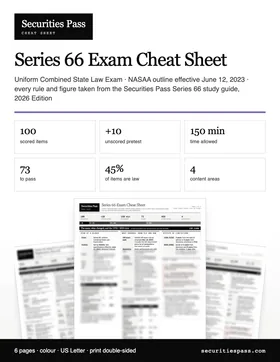
The cheat sheet for this exam
Independent study material, not affiliated with or endorsed by FINRA, the SEC, NASAA or any test-delivery vendor. Rules and figures change; confirm current requirements with NASAA before exam day.
Independent study materials. Not affiliated with, endorsed by or sponsored by FINRA, the SEC or NASAA. Exam names are used only to say which exam a product prepares for.
File last updated October 2026.